Monday, May 28, 2012

(84) Meditations For the Rosary IV: The Glorious Mysteries

  AMDG


A painting by Raphael (1483-1520)

The 20 mysteries of the rosary and their corresponding meditations cover the highlights of the life of Christ and His mother, Mary. Four times through this liturgical year, we have published meditations on a set of five mysteries 1)Joyful, 2)Luminous, 3)Sorrowful, and 4)Glorious that coincide with the Gospels of the liturgical year.  Since the rosary is very biblical, bible references follow each meditation.  As to the repetitive background prayer, the Our Father’s is the prayer the Lord Himself gave to us and the Hail Mary prayer comes from Luke 1:28, 42. At the end of each decade, we give glory and praise to the Holy Trinity……the Father, the Son, and the Holy Spirit.  We don’t adore Mary, but rather we honor her as a model and ask her to pray for us.
        
     Conceptually, the rosary is a litany of repetitive prayers, which act like background music, while the focus is to meditate upon five of 20 different mysteries of the life of Christ and His mother, grouped according to the joyful, luminous, sorrowful, and glorious events portrayed or alluded to in the Bible. See  www.americaneedsfatima.org. 

    The rosary is said with the aid of beads and a connected crucifix, marking the beginning with the Apostles Creed. This is followed by an Our Father for the intentions of the Holy Father, three Hail Mary prayers for the increase of Faith, Hope and Charity plus a Glory Be. Then each decade or mystery includes one Our Father, ten Hail Marys, and a Glory Be (Praise), really a profession of faith.  Please permit me to share insights I obtained from many sources and use while meditating on the holy rosary. You might like to incorporate some of these meditations among yours or add to them.   

        For those who say the rosary every day: The Joyful Mysteries are usually said on Monday & Saturday; the Luminous Mysteries are said on Thursday; the Sorrowful on Tuesday and Friday; and the Glorious on Wednesday and Sunday. The Sunday rosary may use instead the mysteries that correspond to the season of the liturgical year.......Advent, Christmas, Lent, and Easter. The Sorrowful Mysteries are usually said during the entire Holy Week and the Glorious Mysteries are usually said for the entire Easter Week. Of course one may meditate on any set of mysteries. There's no rigid rule.

 “The family that prays together, stays together.” This was the theme promoted by Fr. Patrick Peyton on his Family Theater program on radio and television during the 1940s, 50s, and 60s. He recruited the top movie stars of the day (Jimmy Stewart, Gregory Peck, Bing Crosby, Bob Hope, Loretta Young, etc. and even a young actor by the name of Ronald Reagan) as volunteers to sing or act in inspiring dramatizations on his Family Theater program on radio and television.  Available on DVD is a movie on the Life of Christ which he produced.  Fr. Peyton, the Rosary Priest, promoted the rosary all over the world in talks and rallies. 

    His cause for canonization is advancing.  Go to https://www.youtube.com/watch?v=LXFlEJIpkqQ for one of Fr. Peyton's messages and links to other clips of his productions.  Learn more about this future saint by clicking on http://www.fatherpeyton.org/ and http://www.hcfm.org/FatherPeyton.aspx.  The latter has a link to the online store of the Holy Cross Family Ministries for a wealth of DVDs, books, and other resources regarding his work and the work of his order.
  
In gratitude for his lifetime work Pope John Paul II embraces Fr. Patrick Peyton, the Rosary Priest.

        Prayer has healed millions, ended wars, overthrown dictators, decisively stopped the advance of militant Islam into Europe at least three times at Belgrade in 1456, Le Panto in 1571, and again in breaking the siege of Vienna by the Turks in 1683, each a chapter in a one thousand year old war between Western Civilization and Radical Islam that includes today's War on Terror.  Otherwise, Europe would be a lot different today.

IV. THE GLORIOUS MYSTERIES OF THE ROSARY

            During the Glorious Mysteries, imagine that you have gone through a time capsule and you are there at the tomb during the Resurrection of Christ on the first Easter Sunday, you are with the apostles during His appearances to them; saying good-by to Jesus as He ascends into Heaven; and being filled with the Holy Spirit on the first Pentecost, on fire helping with the many conversions on that day.  
    
        Then we are with the apostles saying good-by to Mary during her dormition, her beautiful death or falling asleep as she is taken or assumed into heaven (body and soul) to be physically reunited with her son before being crowned Queen of Heaven and Earth.  The facts of the Glorious Mysteries of the Rosary are based on the Bible and tradition handed down by the apostles as seen in the writings of the early Church fathers.
  
        Below are meditations for each decade or mystery. One may use the entire meditation or read and reflect only upon the Bible passages as he or she can imagine being there as an observer. In bold is a recommended shorter version when time is limited. Anything in italics is a quote taken directly from the Bible.
The First Glorious Mystery: The Resurrection


       Over the weekend of Good Friday, there was despair among the disciples who put their hopes and trust in their Master, but to their surprise.......HE IS RISEN as He truly said he would. Alleluia! That gave credibility, validation, and vindication to Christ's to His teachings and His saying that He is the Son of God. Without the Resurrection, Christ would go down in history as just another good man or just another prophet who was killed for what He believed.  

      By His resurrection, Christ conquered death, evil, and sin.  God made good come out of evil.  Since Our Lord rose again victorious, we also have the hope of rising again victorious and achieving everlasting happiness with Him in heaven.  No matter how difficult are the crosses we must bear on earth, we can accept and unite them with His cross, TRUSTING that our crosses will make us saints and OUR VICTORIOUS RESURRECTION WILL COME.  All that remained in the tomb was the shroud wrapping the body of Christ.  At the instant that Christ's soul gloriously reentered His body, there was a burst of radiation that scorched the shroud just enough to leave on it an image of the crucified Savior that He left for us to strengthen our weak faith.

       Other options include reading and reflecting during the recitation of this decade on Psalm 16:5-11; Jeremiah 20:10-11; Matthew 16:21-22; 17:22-23; 20:17-19; 27:57-28:15; Mark 15:42-16:13; Luke 23:50-24:48; John 2:19-22; 19:38-21:25; Acts 1:1-3, 21-22; 2:30-32; 4:33; 10:39-43; Romans 1:1-3; 6:3-14; 1Corinthians 15:3-8, 12-22; 1Peter1:18-21. 

The Second Glorious Mystery: The Ascension


The eleven apostles went to Galilee, to the mountain to which Jesus had ordered them to go.  When they saw him, they worshiped, but they doubted.   Then Jesus approached and said to them, "All power in heaven and on earth has been given to me.  Go, therefore, and make disciples of all nations, baptizing them in the name of the Father, and of the Son, and of the Holy Spirit, teaching them to observe all that I have commanded you.  And behold, I am with you always, until the end of the age"  (Matthew 28:16-20).  Christ meant that not only for His apostles, but also for us to evangelize in little or big ways by prayer, by example and witness, by word, and by deed in our daily lives.......be it in the home, in parish functions or apostolates, in the community, in conversation, and even on the job.  

        He promised to always be with us, particularly in the Eucharist.  At the same time our Savior “is seated at the right hand of God, the Father almighty; from there he will come to judge the living and the dead.”  The apostles were sad to see their Master depart and now had to wait to be filled with the Holy Spirit (confirmed) to begin their great mission of evangelization.  Other options include reading and reflecting during the recitation of this decade on Mark 16:14-20; Luke 24:47-53; and Acts 1:6-12.   

The Third Glorious Mystery

 The Descent of the Holy Spirit

       Present were Mary and the apostles....... “When the time for Pentecost was fulfilled, they were all in one place together.  And suddenly there came from the sky a noise like a strong driving wind, and it filled the entire house in which they were.  Then there appeared to them tongues as of fire, which parted and came to rest on each one of them.  And they were all filled with the Holy Spirit and began to speak in different tongues, as the Spirit enabled them to proclaim” (Acts 2:1-4). 

    May the Holy Spirit renew in us the graces and His gifts of the sacrament of Confirmation as well as His fruits.  As soldiers of Christ, may we be always faithful to the Lord and His Church.  As were the first apostles, may we also be fearlessly on fire for the faith......to defend it, to spread it, and to share it with others no matter the cost.    Dear Holy Spirit, always tell us what to do, what to say, and what to write.  Other options include reading and reflecting during the recitation of this decade on Psalm 2:1-7; 104:30; 118:1-9,19-29; Ezekiel 37:14; Joel 3:1-5; Mark 16:14-20; John 3:5-8; 7:37-39; 14:15-28; 15:26-27; 20:19-23; Acts 1:4-5; 2:1-41; 3:12-26; 4:5-14; 23-31; Romans 8:22-27; 1 Corinthians 12:3-13; Galatians 5:13-26; 1 Peter 1:10-12.


The Fourth Glorious Mystery: 
The Assumption of Mary into Heaven

                                                    
        According to tradition, the apostles joyfully found only the most beautiful flowers where Mary previously laid in state.  Christ followed the 4th Commandment in honoring His mother by having her body and soul taken directly into His arms in Heaven.  Our Lord would not allow her body, a living tabernacle for nine months, the new Ark of the Covenant, to deteriorate in the earth. 

        Mary’s womb, the new Ark, did not contain manna, but the Bread of Life which is the Eucharist, Christ Himself.....not the staff of Aaron, but the Good Shepherd and High Priest who will offer Himself for us…..not the Ten Commandments, but the Son of God, who will speak for the Father.

        All of Heaven received Mary with immense joy.  Mother Mary, pray for us so that we may have a happy death as you had.  Other options include reading and reflecting during the recitation of this decade on Judith 13:18; Luke 1:39-56; 11:27-28; 1 Corinthians 15:20-27, 54-58; 1 Thessalonians 4:14-17; Revelation 11:19; 12:1.


The Fifth Glorious Mystery: 
The Coronation of Mary as Queen of Heaven & Earth


Imagine that you are there with all Heaven rejoicing in jubilation as Mary is gloriously crowned Queen of Heaven and Earth by her Son and the Father with the Holy Spirit looking on.   In the tradition of the Old Testament, the Queen Mother of Christ the King of the universe took her place of special honor and influence in the heavenly court.  From there our mother continues to intercede and pray for us and the world. 

Other options include reading and reflecting during the recitation of this decade on Judith 15:9-10; Revelation 12:1-6.  For meditations on the Joyful, Luminous, Sorrowful, and Glorious Mysteries of the rosary go to Blogs # 50, 73, 78, and 84 at paulrsebastianphd.blogspot.com.


Monday, May 21, 2012

(83) The Role of Mary in the Church


  AMDG
               

The beautiful month of May is special in giving a temperate preview of summer as the Spring flowers are in bloom.  Since the Church dedicates this month to Mary, let us examine her role in the Church.  

            One of the biggest problems for prospective converts besides the Eucharist is Mary.  But she should not be.  We don't worship her.  We honor her as we honor any other hero of our country.  Yes, we do ask her to pray for us the same as I would ask you to pray for me and for the success of our Newman Club even though we all believe that there is only one mediator between God and man.  Millions over the centuries flock to the many great and often magnificent churches or shrines, full of art such as Notre Dame in Paris and Chartres France, to honor Mary, to ask for her help through her prayers to God, and for her motherly nurturing.  The United States has in its capital, Washington D.C. the magnificent Shrine of the Immaculate Conception of Mary, its patroness.  The basilica took years to build.  

             Any devotion to her is optional.  However it is considered as Church doctrine and required belief that she was immaculately conceived without the stain of  original sin and that she was bodily assumed into Heaven as we will be at the Last Judgment.  Since her womb was the first tabernacle and the new Arc of the Covenant that carried God Himself, it is only logical that God would create her without original sin and would not let her body deteriorate in the earth.  This is based upon Church tradition handed down by the apostles, but not recorded in the Bible.  The writings of the early Church Fathers of the first three centuries do mention her.  They refer to Mary as the new Eve who said yes to God at the Annunciation by the Angel Gabriel (See http://principiumunitatis.blogspot.com/2009/11/early-church-fathers-on-mary-as-new-eve.html  and http://www.staycatholic.com/ecf_immaculate_conception.htm). 

            Mary's role in the Church is to nurture the Faith, to bring us closer to her Son, and to help us to follow Him and His teachings.  We see some of this at Cana in the Gospel of John 2:5 where Mary instructed the chief steward:  “Do whatever He tells you”.  After all the role of a mother is to nurture and she is our mother whom Christ gave to us from the cross before He died.  After giving Himself in the Eucharist on Holy Thursday and while redeeming us on Good Friday, He gave us His mother with the words Woman, behold your son” and to St. John by his own testimony, “Behold your mother” John:26-27).

            The Immaculate Heart and the Sacred Heart are in such intimate union, that she would only do the will of her son.  She has no power in herself.  Any power that she might have, is given to her by God to carry out His will.  She is completely dependent upon Him.  Mary is like the moon and in reflecting the light of the Son.  Examples of her nurturing are through her apparitions and resulting shrines.  There are hundreds of claimed apparitions, but relatively few are approved by the Church as worthy of belief (See http://www.catholicdoors.com/isit/approved.htm).  However, Catholics are not required to believe any of them.
 
            Lourdes.  The Catholicism Series only mentions the shrines of Guadalupe, Fatima, and Lourdes, where thousands of healings have occurred.  However, only about 75 have passed the strict scrutiny of the Church (a panel of doctors) as being beyond human explanation.  Among the thousands of sick who go there for healing, a significant number are actually healed physically, but almost all of them undergo a certain healing of soul.  They become closer to God and are better able to cope with their great crosses.  Any miracle, used to support the beatification or canonization of a saint as a sign from God that he or she is a person of extraordinary holiness and heroic virtue, must pass the same scrutiny.

            At the Shrine of Our Lady of Guadalupe in Mexico City over the main altar of the Basilica is the miraculous image which appeared on the tilma of Juan Diego when he presented the roses that Mary sent to the Bishop as the requested sign.  The image is full of symbols that only the Aztecs understood as a message that they should follow the religion of the Spaniards.  In a few years 8 million Indians converted to the faith, replacing all of those lost to Protestantism during the Reformation.  Thus Mary is the greatest missionary of them all.  The sash Mary is wearing indicates that she is pregnant.  Thus Mary has been designated as the "Patroness of the Unborn".  The fact that the Aztecs then stopped making human sacrifices of adults, children, and babies to their pagan gods connects her intimately to the Pro-life Movement.  See my blogs #104, 105, and 106 for more detail. 
 
            Is the Hail Mary prayer biblical?   Absolutely.  “Hail Mary full of grace, the Lord is with thee” (Luke 1:28 in the Annunciation).  Blessed art thou among women and blessed is the fruit of thy womb (Luke 1:42 in the Visitation).  Were the Angel Gabriel and St. Elizabeth worshiping Mary?  Obviously not.  The second part of the prayer continues:  “Holy Mary, mother of God, pray for us sinners now and at the hour of our death amen”.  Clearly, the prayer first honors Mary and then asks her to pray for us, not worshiping her at all.  She was overshadowed by the Holy Spirit the same as God in the cloud overshadowed the Arc of the Covenant of the Israelites during the sojourn in the desert.   In Christ, the human and the divine come together.....true God and true man  Thus Mary is indeed the Mother of God, i.e., the human nature of Christ.
   
           There are only two religions in history that have placed a woman in such high esteem......the Catholic Faith and the Orthodox which broke away in 1054.

         Fatima.  Interesting is that the Qur’an devotes the entire chapter 5 to Mary as the most perfect woman that God ever created (See http://campus.udayton.edu/mary/QuranAndMary.htm).  Also interesting is the Muslim source, http://www.mostmerciful.com/jschinqr.htm.   Fascinating is the fact that when the Moors conquered and occupied most of Spain and Portugal, the Muslims named a small Portuguese town, Fatima, after Mohammed’s favorite daughter, Fatimah.  It was no accident that Mary chose that little village as the place of one of her most famous apparitions to three shepherd children in 1917.  Is Mary reaching out to Islam?  

          At Fatima Mary said that World War I would soon end, but if the world did not repent, there would be a  worse world war; Russia would continue to spread its errors; and there could be even a third world war.  That was before the Russian Revolution.  Shortly before the start of World War II there would be “a night illumined by an unknown light”.  My blog #95 has a clipping from the London Times of January 27, 1938 that documents it and that same blog has other photos and explanations in regard to the apparition.

            The Rosary.  Mary asks us to pray the rosary to bring us closer to God.  The repetitive prayer serves as background music while the focus is on meditating on either the Joyful, Luminous, Sorrowful, and Glorious Mysteries in the life of Christ and Mary, almost all of which is Biblical.
 
            Thus we can see the truth in the old Catholic saying:  “To Jesus through Mary”.


Wednesday, May 2, 2012

(82) National Day of Prayer: Prayer for the Military and Veterans Still Hurting


       The National Day of Prayer has been an annual observance since 1952 when Congress officially established it.  Every year the President of the United States and most state governors issue proclamations on or prior to the first Thursday of May.  People all over the United States are asked to assemble at noon on the first Thursday of May at their county court houses to pray for our Country.  If that is not possible or inconvenient, then people are asked to at least pause for a minute or two at noon to pray.  God knows how much our Country needs prayer.

        It has been observed at the University of Rio Grande in southeastern Ohio since 1998.  Faculty, staff, students, and guests meet at the gazebo between the Bookstore and the cafeteria to pray for our country.  

 PRAYER FOR THE MILITARY AND VETERANS STILL HURTING
Given in Observance of the National Day of Prayer at the University of Rio Grande 26 April 2012, 23 April 2015, 25 April 2016.
Published in the Gallipolis Daily Tribune on Tuesday, November 11, 2012 for Veteran's Day.

O Lord, we beseech thee first and foremost to grant us Peace in Afghanistan, Iraq, Syria, and the world. Because war is hell, all good soldiers must yearn for Peace, the ultimate goal in which lie their own personal aspirations and the aspirations of the entire Country.

Purify the motives of every soldier to be aware that the ultimate mission of the military in defending our Country is to achieve peace through victory while preserving human dignity to the greatest extent possible....... combatants and non-combatants, friend and foe.......all as children of God.

Protect our troops who are in harm's way.........from enemy and even friendly fire, IEV's, ambushes, and accident.

Guide our NCOs and commissioned officers to lead effectively and to accomplish the mission with prudence and wisdom while caring for their men and women without risking their lives unnecessarily. Remind them to seek your counsel in the life and death decisions they must make.

Remind our men to look out for each other as they all strive to survive in the heat of battle.

Maintain the morale of the troops. Preserve the patriotic and spiritual ideals of our young men and women, their sense of moral right and wrong so that they do not become cynical as they live through the horrors of war while fighting for our Country.

Help our soldiers to treat prisoners of war with dignity as human beings and even with a certain compassion despite the fact that the enemy may have committed monstrous atrocities upon their buddies. Don't let us ever lower ourselves to seek revenge with atrocities of our own.

Inspire our troops to also work for the common good of all........to be effective ambassadors of good will, and win the hearts and minds of the people while accomplishing the mission.

Make our officers ever aware of the consequences of their decisions upon people in regard to the safety of their troops and collateral damage to the populace.......to be prudent in not using more force and causing more destruction and casualties than is necessary to accomplish the mission.

Give our troops the grace to maintain high moral principles on and off base, while on a mission or during a break in the action. Bring them ever closer to you so that they will leave the service as true men and women of God.

Help the families that the soldiers have left behind to cope by themselves with the difficulties of daily living and problems that come up.

Lord, please assist the thousands of veterans in our midst, who are still suffering for us and for our Country with permanent physical injury, loss of a limb, PTSD, flashbacks, and mental anguish.

And Lord, help us to appreciate the sacrifices that the troops are making now and the veterans did in the past and are continuing to make. Help them to adjust to civilian life and to provide for themselves and their families with dignity. Make us sensitive to their needs and don't let our Society tolerate the presence of homeless veterans who cannot function because of the sacrifices they made for us while soldiers.

We ask all of this in your name Oh Lord. We praise you and thank you for loving us so much. Amen.


Supplemental Bible Verses

2 Chronicles 7:14 (New International Version)

“If my people, who are called by my name, will humble themselves and pray and seek my face and turn from their wicked ways, then I will hear from heaven, and I will forgive their sin and will heal their land.”

1 Timothy 2: 1-4

1First of all, then, I ask that supplications, prayers, petitions, and thanksgivings be offered for everyone, 2for kings and for all in authority, that we may lead a quiet and tranquil life in all devotion and dignity.  3This is good and pleasing to God our savior, 4who wills everyone to be saved and to come to knowledge of the truth.

Verse I Chose for the Prayer I Gave at Rio

2016 - 2 Cor 10:4  "For the weapons of our warfare are not carnal, but mighty in God for pulling down strongholds."

2015 - Psalm 91:2-7  I will say of the Lord, “He is my refuge and my fortress, my God, in whom I trust.” Surely he will save you from the fowler’s snare and from the deadly pestilence. He will cover you with his feathers, and under his wings you will find refuge; his faithfulness will be your shield and rampart. You will not fear the terror of night, nor the arrow that flies by day, nor the pestilence that stalks in the darkness, nor the plague that destroys at midday. A thousand may fall at your side, ten thousand at your right hand, but it will not come near you.


Theme and Verse of the Year

2016 - Wake up, America!  Isaiah 58:1a  “Shout it aloud, do not hold back. Raise your voice like a               trumpet.”
2015 - I Kings 8:28  “Hear the cry and the prayer that your servant is praying in your presence this                 day.”
2014  - Romans 15:6 "One Voice, United in Prayer".
2013 - Matthew 12:21 - “In His name the nations will put their hope.”
2012 - A mighty fortress is our God!  Psalm 33:12 - “Blessed is the nation whose God is the Lord,       the people he chose for his inheritance.”
2011 - Psalm 91:2 “I will say to the Lord, “My refuge and my fortress, my God, in whom I trust.”
2010 - Nahum 1:7 “The Lord is good, a refuge in times of trouble.  He cares for those who trust in Him.” 

Tuesday, May 1, 2012

(81) May Day and St. Joseph the Worker: Model of a True Man of God

MAY DAY

Images of the Hay Market Massacre, Chicago May 1886

          May 1 has been celebrated throughout the Communist world as May Day to commemorate the Hay Market Massacre in Chicago.  From April 25 to May 4, 1886 Chicago unionists, reformers, socialists, anarchists, and ordinary workers demonstrated for the eight hour day with the same pay as the normal ten at least 19 times with a dozen or so clashes with the police, three with shootings and two were killed.  At this time the union movement was in its infancy and met with vehement resistance by companies.  About 35,000 workers walked off their jobs with agitation for a general strike at all work places.  Police fired on strikers at the McCormick Reaper Plant; violence ensued; and police fired on the strikers, killing two.  

      Leaders called for a protest meeting at the Hay Market on the evening of May 4 with one inflammatory leaflet agitating for revenge.  Although the mayor who attended instructed the 177 police not to disturb the meeting, the officer in charge ordered the crowd to disperse.  Someone threw a bomb and the police fired indiscriminately into the crowd, much like the Kent State shootings on May 4, 1970 when inexperienced National Guardsmen killed four students died and injured several others (http://dept.kent.edu/sociology/lewis/lewihen.htm).  Sixty police were injured and eight died.  Many in the crowd were killed or wounded.  The city of Chicago then suppressed picketing, meetings, and the radical press.  Seven of the striking leaders were sentenced to death based on a conspiracy theory with little or no evidence.  It never was determined who threw the bomb (http://www.encyclopedia.chicagohistory.org/pages/571.html , http://dwardmac.pitzer.edu/anarchist_archives/haymarket/haymarket.html).

          In memory of the Hay Market Massacre Socialists and unionists around the world adopted May 1 or May Day as an international workers' holiday.  In the 20th Century the Soviet Union and the Communist World officially adopted it.  Thus it never caught on in the United States except for a period before World War I.  May Day is still celebrated in many nations of the world, especially in Latin America, Eastern Europe, and the communist countries (China, North Korea, Vietnam, Laos, and Cuba).  The communist countries have traditionally celebrated with big parades celebrating the Socialist Revolution with supposedly promises a workers paradise with equality and a equitable distributions of goods plus showing off their technological progress and modern armaments.  


          In reaction to the atheistic communist celebration of May Day in honor of their workers and the revolution against capitalism, Pope Pius XII adopted the same day, May 1 in 1955 as the Feast of St Joseph the Worker.  The painting below shows that Christ came from a working class family with St. Joseph the Carpenter as its head.  

ST. JOSEPH THE WORKER: 

MODEL OF A TRUE MAN OF GOD

  
      Why is St. Joseph a model of a true man of God? The Bible says little about St. Joseph and does not quote him at all. Yet the biblical accounts of St. Joseph demonstrate or imply several of his virtues; tradition shows others.....stories written and unwritten that have been handed down through the generations.

         Ever Chaste. According to tradition, Mary's parents, Joaquin and Ann asked God for a sign as to which man would be best for their daughter. Within a group of men St. Joseph's staff suddenly sprouted a white Lilly, a symbol of purity.  St. Joseph was ever chaste and able to control his passions and give up the privilege of having children of his own so that Mary could maintain her virginity as God willed.

        Sensitivity. We see that in Matthew 1:18-21. When His mother Mary was betrothed (engaged) to Joseph, but before they lived together, she was found with child through the Holy Spirit. Joseph her husband, since he was a righteous man, yet unwilling to expose her to shame, decided to divorce her quietly. Such was his intention when, behold, the angel of the Lord appeared to him in a dream and said, “Joseph, son of David, do not be afraid to take Mary your wife into your home. For it is through the Holy Spirit that the child has been conceived in her.. She will bear a son and you are to name him Jesus, because he will save His people from their sins.”

        St. Joseph shows sensitivity in not exposing Mary to shame and protecting her from scandal or even stoning. Thus he tried to quietly separate from her. But Joseph obeys the angel without question and trusting in God, takes Mary into his home and provides for his wife and child. 

        Complying with the decree of Caesar Augustus for a census, Joseph took his pregnant wife on a trip of at least four days to travel the 80 miles from Nazareth to enroll in Bethlehem the city of David because he was a descendant of David. They had to patiently cope with the uncertainty that Mary would have to give birth on the side of the road as they continued to trust in God throughout their lives.  Thus they probably traveled slowly with frequent rest stops during a long, tiring, and bumpy ride.  According to tradition, Mary rode on a donkey and Joseph showed toughness in walking at her side. He did the same in the over 300 mile flight to Egypt and annual trips to the Temple in Jerusalem for the Passover. 
 
        Once in Bethlehem they could not find room in any of the inns and had to resort to the humiliation of staying in a stable. On top of that Mary gave birth to the Christ child. Joseph courageously coped with these difficulties, continued to trust, and made the best out of a bad situation which was transformed into the joy of the promised Messiah’s birth. 
 
        Obedient and Trust in God. To save the Christ child from Herod's slaughter of the holy innocents, Mathew 2:13-15 shows that the angel of the Lord appeared to Joseph in a dream and said, "Rise, take the child and his mother, flee to Egypt, and stay there until I tell you. Herod is going to search for the child to destroy him." Joseph rose and took the child and his mother by night and departed for Egypt. He stayed there until the death of Herod. In verses 19-20: When Herod had died, behold, the angel of the Lord appeared in a dream to Joseph in Egypt and said, "Rise, take the child and his mother and go to the land of Israel, for those who sought the child's life are dead." He rose, took the child and his mother, and went to the land of Israel. But when he heard that Archelaus was ruling over Judea in place of his father Herod, he was afraid to go back there.  And because he had been warned in a dream, he departed for the region of Galilee. He went and dwelt in a town called Nazareth, showing great prudence.

        Clearly, St. Joseph has the role of protector from the brutal Herod and on the long and arduous journey of a couple weeks to travel over 300 miles to an unknown land, Egypt. According to tradition, a Coptic church in Cairo Saints Sergius and Bacchus Church, also known as Abu Serga claims to be the site of the home of the Holy Family. Again, Joseph places his trust in the provident God and obeys. Again Joseph bends his will to the will of God, his plans to God's plans. On their return, St. Joseph is prudent in not returning via Judea for fear that Herod's son, Archelaus now king of Judea and even more violent than his father, would put the Holy Family in danger again. Thus Pope Leo XIII entrusted the Church to the protection of St. Joseph. Being a quiet man and dependent upon God, he demonstrated his humility.

        In the presentation in the Temple and going there every year for the Passover, St. Joseph is faithful to Jewish law. They presented and consecrated Mary's first born son to the Lord while sacrificing two young pigeons (Luke 2:22-24).

        When the 12 year old Christ child was lost in the Temple (Luke 2:41-52), Joseph and Mary had “great anxiety”. Surely thoughts of failure in their mission entered their minds, but Joseph must have had the faith that God was in control and would work it out.
 
        Physically Strong and Rugged. St. Joseph was a carpenter and according to custom trained his son in his trade.  They worked together during those hidden years which are not recorded in scripture.  We can only draw on tradition, private revelation to the mystic, Anne Catherine Emmerich as well as legend and speculation.  Holy pictures show a small carpenter shop for furniture making.  But some scholars say that St. Joseph and the young Jesus were construction carpenters that did heavy work.  Therefore both St. Joseph and his son were strong, rugged, and tough, epitomizing the dignity of work as creating with God.  St. Joseph was able to walk the 80 miles from Nazareth to Bethlehem and over 300 miles to Egypt.  This contradicts some popular depictions of St. Joseph as effeminate.  Thus Christ was able to walk all over Palestine and drag the cross or carry the crossbeam which weighed 100-150 pounds.  Clearly, St. Joseph served Mary and Jesus by being the breadwinner and by providing for the Holy Family.

        Piety. St. Joseph, being a pious man, certainly led his family in prayer and taught his son how to pray and observe the mosaic law.  He probably took the Holy Family to the synagogue every Saturday.  In his Gospel St. Luke (2:41) explicitly states in his Gospel: “Each year his parents went to Jerusalem for the Feast of the Passover”. Each time the angel communicated God's will that the Holy Family should flee to Egypt and again when to return, it was to Joseph, the head of the family. Clearly St. Joseph was the spiritual and material leader of the Holy Family. His quiet way indicated that he loved his family without being controlling.

         So we can see that St. Joseph was holy, a self-giving husband, a loving father, and a true man in every respect as God intended.  ST. JOSEPH, MODEL OF A TRUE MAN OF GOD, PRAY FOR US.

Note: For an excellent book see "St. Joseph and His World" by Mike Aquilina (www.scepterpublishers.org).  Well researched, it not only describes the role of St. Joseph in salvation history, but also beautifully describes the historical, socioeconomic, cultural, and environmental context of his role.  Thus it makes the scriptural passages involving St. Joseph come alive and gives insights on the hidden life of the Holy Family.  The first chapter gives an excellent summary of salvation history that was passed down from one generation to the next as the Jewish people waited in anticipation for the coming of the Messiah.

Sunday, April 15, 2012

(80) The Divine Mercy Message and Our Four Visits to the Divine Mercy Shrine in Krakow, Poland

AMDG
The first painting in the Vilnius convent by Kazimierowski which more closely follows the instructions of St. Faustina.

The later more popular second painting by Hyła that is seen in most Catholic Churches around the world.
              Christ appeared to a semi-literate simple but holy nun by the name of Maria Faustina Kowalska a number of times at her order's convents in Plock-Poland, Vilnius-Lithuania, and Krakow-Poland beginning in 1931. He asked her to record the conversations in a diary which became a book, “Divine Mercy in My Soul”, which has been translated into many languages. This classic is also on line at http://www.saint-faustina.com/Diary/DMIMS1.shtml and can be bought from www.ewtn.com. 

     The main message is that Christ not only is a God of justice but also a God of mercy, who anxiously waits to bring souls back to Him as innumerable sins drown in the ocean of mercy. We in turn should show mercy to others through kindness and love as we forgive those who have hurt us. At the same time the Redeemer wants us to place all of our trust in Him, no matter how bad things. Then sooner or later will come the victorious resurrection for those who trust.

     The Image. Our Lord asked St. Faustina to direct an artist Eugene Kazimierowski to paint what she saw. It is pictured above on the left and remains in the order's Vilnius-Lithuania convent, where most of the appearances occurred. The painting was the best the artist could do after trial and error. St. Faustina was never satisfied because no artist could duplicate exactly the beauty and majesty what she saw. After her death in 1938, Adolph Hyla painted a second image on the right in thanksgiving for surviving the second world war. The latter stood for many years to the left of the main altar of the convent chapel. In 2002, a magnificent basilica shrine was completed on the grounds of the convent. The image now stands over the main altar there.

       Notice the white and red rays protruding from our Lord's sacred heart. They are rays of love, grace, and mercy. The white rays symbolize the purifying water of Baptism and the red rays the blood He shed for us. This is reminiscent of the heart of Christ being pierced by the lance of the soldier after Christ died on the cross and a mixture of water and blood flowed out from His heart through His side (John 19:31-37).


          Differences between the first and second paintings of Christ as described by St. Faustina.  Eugene Kazimierowski painted the first image according to what St. Faustina personally described.  Adolph Hyła tried to improve on it according to the description left by St. Faustina in her diary.  After the Soviet invasion, the occupiers looted the convents and churches of paintings.  However, they overlooked the image of Divine Mercy and a priest left it in an attic until discovered years later.  Thus the second painting by Hyła was placed in the convent chapel in Krakow.  The apparitions and paintings were relatively unknown outside the order until Blessed Pope John Paul II spread the Divine Mercy devotion to the entire world.


          St. Faustina’s spiritual director, Fr. Michael Sopocko actually had objections to the second image.  In the first image the darkness behind Christ is more apparent to indicate that Christ is the light of the world.  According to Church regulations at the time, a priest was not supposed to make a blessing with his hands above the shoulders.  Our Lord wanted to adhere to the norms of the Church to indicate that “Whatever thou shall bind on earth shall be bound in heaven” (Matthew 16:19 & 18:18).  The second image does not adhere to that norm.  In addition the image of Christ is not as manly in face and body as in the first.  Furthermore, the rays of red and pale white are supposed to be closer together as a blend since it was a mixture of blood and water that poured out from the side of Christ John 19:34). See
http://www.thedivinemercy.org/library/article.php?NID=2826.      

Blessed Pope John Paul II, the Vicar of Christ, in front of the second image in the original convent chapel, before construction of the large church.

       Trust. The inscription below the image, “Jezu ufam tobie” translates to “Jesus, I trust in you.” Our Lord challenged us through St. Faustina to trust Him:

      "Your duty will be to trust completely in My goodness, and My duty will be to give you all you need. I am making Myself dependent upon your trust: if your trust is great, then My generosity will be without limit."  (Divine Mercy in My Soul para.548) In paragraph 1578 we see: “The graces of My mercy are drawn by means of one vessel only, and that is trust. The more a soul trusts, the more it will receive”.

      Trust constitutes the foundation of the Divine Mercy devotion. It means complete acceptance of God's will, seeking it in making decisions, and praying for His will to be done in our lives especially in career decisions.  "Fear nothing l am with you always" (Diary 586).  "Humanity will not find peace until it turns trustfully to divine mercy" (Diary, 300). As John Paul II, the Mercy Pope said, Divine Mercy is a message for the new millenium.

      Mercy towards one's neighbors is the second most essential element of the Divine Mercy devotion. The Lord reminds us through St. Faustina about the basic Christian duty in paragraph 742. “You are to show mercy to your neighbors always and everywhere. You must not shrink from this or try to excuse or absolve yourself from it.

        I am giving you three ways of exercising mercy toward your neighbor: the first-by deed, the second-by word, the third-by prayer. In these three degrees is contained the fullness of mercy, and it is an unquestionable proof of love for Me. By this means a soul glorifies and pays reverence to My mercy. Yes, the first Sunday after Easter is the Feast of Mercy, but there must also be acts of mercy, and I demand the worship of My mercy through the solemn celebration of the Feast and through the veneration of the image which is painted. By means of this image I shall grant many graces to souls. It is to be a reminder of the demands of My mercy, because even the strongest faith is of no avail without works.”

    In the revelations, our Lord expressed a desire that each of us should be witnesses of Divine Mercy.......perform out of love for Him through deed, word, or prayer at least one act of mercy toward our neighbors every day. Mercy is of greater merit for the soul and adds that one does not need material resources to perform acts of mercy. Indeed it is a requirement of the Gospel.......specifically the Corporal and Spiritual Works of Mercy.

         Corporal Works of Mercy
    • To feed the hungry;
    • To give drink to the thirsty;
    • To clothe the naked;
    • To shelter the homeless;
    • To visit the sick;
    • To ransom the captive;
    • To bury the dead.

         Spiritual Works of Mercy
    • To instruct the ignorant;
    • To counsel the doubtful;
    • To admonish the sinner;
    • To bear wrongs patiently;
    • To forgive offenses willingly;
    • To comfort the afflicted;
    • To pray for the living and the dead.
       A Wonderful Promise of Mercy. Christ also directed the world to pray the Chaplet of Divine Mercy, especially at 3 pm, the hour of grace when He died on the cross. The Chaplet is a litany asking for mercy while meditating on the passion. You can watch it being recited on EWTN television or on the internet at http://www.ewtn.com/Live/unicorn/jwplayer.asp?bottom=false&feed=domeng any day at 3 pm. For details on how to say the Chaplet and selected quotes from her book, see http://www.ewtn.com/devotionals/mercy/dmmap.htm.
         Furthermore, Christ promised that if the Chaplet is recited in the presence of a dying person, He would come to him or her:
"....When they say this Chaplet in the presence of the dying, I
will stand between My Father and the dying person not as the just
judge but as the Merciful Savior"
(Divine Mercy in My Soul).
My wife Jaga and I have had that privilege a few times since we regularly bring Holy Communion to the sick as Eucharistic Ministers.
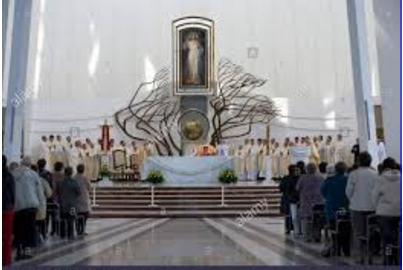
The main altar of the Divine Mercy Shrine in Krakow during the Holy Sacrifice of the Mass.
       Divine Mercy and the Eucharist. In paragraph 1447 Christ expresses His love in Holy Communion. “Oh, how painful it is to Me that souls so seldom unite themselves to Me in Holy Communion. I wait for souls, and they are indifferent toward Me. I love them tenderly and sincerely, and they distrust Me. I want to lavish My graces on them, and they do not want to accept them. They treat Me as a dead object, whereas My Heart is full of love and mercy. In order that you may know at least some of My pain, imagine the most tender of mothers who has great love for her children, while those children spurn her love. Consider her pain. No one is in a position to console her. This is but a feeble image and likeness of My love.”
       Some History. For years the Vatican would not approve the visions of Sister Faustina, who died in 1938, as worthy of belief.   In fact they suppressed her writings and put her work on the Index of Forbidden Books from 1959-1966. As God's providence works, a young Karol Wojtiła was working at a quarry near the convent during the German occupation in the early 1940s and learned about Faustina from the nuns when he visited their chapel.

      By 1963 this youth became the Archbishop of Krakow. He investigated the visions and Faustina's writings and interviewed witnesses, becoming convinced of her holiness and the authenticity of the revelations and her writings. Theologians were amazed how a simple woman with only a third grade education could write a book with such profound depth. In 1967, the year he was made Cardinal, Wojtiła submitted documents about Faustina to the Vatican, requesting that the process of her beatification begin and it did in 1968. In 1977 he asked the Vatican to review and lift the ban on the Divine Mercy devotion. The Prefect of the Sacred Congregation for the Doctrine of the Faith lifted in April 1978 a few months before he was elected Pope in October. The misunderstandings were all due to a faulty translation into Italian.
St. Faustina with the original image of Divine Mercy by Kazimierowski.

       After being elected Pope in 1978, his second encyclical was on Divine Mercy titled, Dives in Misericordia (The Father of Mercies and God of all Comfort) November 30, 1980 and her cause for canonization was opened. In 1993 Pope John Paul beatified her and on April 30 2000, the First Sunday After Easter, he canonized her as a saint of the Catholic Church.......the very first of the new millennium. In his homily of that Mass, the Pontiff declared the First Sunday After Easter as Divine Mercy Sunday throughout the world according to the request of our Lord to St. Faustina, close to 70 years before.
          Divine Mercy Sunday and Special Graces. One may obtain special graces by saying the Divine Chaplet for nine consecutive days beginning Good Friday with a different intention and prayer each day as follows: 1) All mankind, especially sinners; 2) The souls of priests and religious; 3) All devout and faithful souls; 4) Those who do not believe in God and those who do not yet know me; 5) The souls of separated brethren; 6) The meek and humble souls and the souls of little children; 7) The souls who especially venerate and glorify my mercy; 8) The souls who are detained in Purgatory; 9) Souls who have become luke-warm.
        Anyone who receives Holy Communion on Divine Mercy Sunday and goes to Confession within three weeks of that day will receive a plenary remission of temporal punishment in Purgatory.
         Our 1995 Visit. At that time Divine Mercy was relatively unknown. I learned about it when I taught at Franciscan University of Steubenville 1980-83. During my first visit to see Jaga's family, I asked to see the Shrine of Divine Mercy. To my surprise hardly anyone knew anything about it. True, Communism had been overthrown only six years before, but they did have a relative freedom of worship, but very limited freedom of religion where the Church could freely build churches, have their own newspapers, schools, minimal government interference, etc. A coworker of Janusz, my sister-in-law's husband, said it was in the Łagiewniki section of Krakow. We went there and had to ask several people before one could tell us where it is.
The old convent with the original chapel in which our Lord appeared to St. Faustina

        Finally, we found this old walled convent by trial and error and asking people who did know as we got closer. As we entered, we saw a large open air theater for Masses on Divine Mercy Sunday some five or six thousand people would come. We found the chapel and was on time for the Mass at 3 pm, the hour of grace when Christ died. The chapel only has room for some 150 people; so many had to stand outside. The artist Adolph Hyla's conception of Christ, as described by St. Faustina, looked stunning over a small altar to the left of the main altar.
        Fascinating was the story of the shrine by a nun from Texas, of all places. In the 1980s she was on a tour of Polish shrines. A priest in the group asked the Communist guide to take the group to the Shrine of Divine Mercy. He didn't know where it was, but they did find it. This young woman returned to the United States enthralled by the Shrine and the Divine Mercy message. After a few months, the Texan was convinced she had a vocation to the Polish order. Thus this girl from Texas joined the order and learned Polish, which she spoke very well.
       Much of what we learned from her is described in this article. One story concerns the time when a beggar knocked at the door of the convent. St. Faustina gave him some food and later Our Lord revealed that He was the beggar. This certainly reinforces what Christ said during His public life “Whatever you did for one of these least brothers of mine, you did for me” (Matthew 25:40).
        Christ revealed to St. Faustina that if there is even a glimmer of good will in a dying person, He would try to take advantage of it. So this American had to tell our Polish relatives about the fabulous Shrine of Divine Mercy three hours away from them.
The final stop for 6 million Jews as St. Edith Stein and also gentiles
such as the Polish priest St. Maximilian Kolbe.  The Nazis were merciless.


         1999. We stopped at the shrine after we visited Auschwitz, a very somber visit. Some 6 million people were exterminated there, mostly Jews but a significant number of Christians. There was heroism there too as when St. Maximilian Kolbe gave his life so another prisoner could live. St. Faustina foretold that war. As I reflected at the monument there, a terrifying thought entered my mind: “What about our Holocaust? Hitler killed 10 million Jews; we killed 53 million babies since the legalization of abortion in 1973. Our country is indeed in great need of the Lord's mercy! This visit was brief and we heard Mass late in the afternoon. At this time, they were raising money for the new basilica and that year began construction.
         2007 and 2008. While teaching in Kielce during the Spring Semesters of both years, I had the opportunity to visit the shrine on Divine Mercy Sunday by bus. Each time there was a throng of over 50,000 people gathered in a field below an outside altar to the right of the Basilica. Cardinal Stanisław Dziwisz presided at the open air Mass each time. He was the secretary and confidant of Karol Wojtila as Archbishop of Krakow and as Pope John-Paul II.
  
    The Basilica of the Shrine of Divine Mercy is of modern architecture and beautiful with a tower overlooking the convent grounds and the surrounding countryside. The view is great. The original convent and chapel are the red brick buildings in the background. 
        Once Pope John Paul II canonized St. Faustina and declared the Sunday after Easter as Divine Mercy Sunday, the Divine Mercy devotion grew rapidly. Today everyone in Poland has heard of the Divine Mercy Shrine. Today every Catholic Church in the world celebrates Divine Mercy Sunday. Almost every church in Poland and many in the United States have an image of Divine Mercy.
        God's Mercy in the Bible occurs many times in the Bible as early as Exodus 20:6; 1Samuel 12:7; 1Chronicles 21:13; 2Chronicles 5:13; Hosea 6:6; in the psalms and throughout the New Testament as Matthew 5:7; 9:13; 12:7; 23:23; Luke 1:50,54, 58,72,78; 10:37; 18:9-14, etc. The Prodigal Son and the Good Samaritan are excellent examples of mercy.  A little study will show that there is no contradiction between the Bible and the Diary of St. Faustina, i.e. Divine Mercy in My Soul.  In fact, it reinforces the Bible.