Showing posts with label Poland. Show all posts

Tuesday, October 23, 2012

(98) Memories of Seeing Blessed Pope John Paul II Three Times When He Visited Detroit September 18-19, 1987.......25th Anniversary This Year

AMDG


Memories of Seeing Blessed Pope John Paul II Three Times When He  Visited Detroit September 18-19, 1987.......25th Anniversary This Year 

        October 22, 2012 is the Feast Day of Blessed Pope John Paul II, the night of the last Presidential Debate between Mitt Romney and President Obama, and also the night that the San Francisco Giants beat the St. Louis Cardinals 7-0 in the seventh game and win the National League Pennant after being behind three games to one.  They meet the Detroit Tigers in the World Series two days later.  In September 1987 there also was pennant fever in Detroit which came back to win the Eastern Division Championship of the American League on the final weekend of the season against the Toronto Blue Jays with a final record of 98-64.  

         That same month in 1987 there was excitement in Detroit for another reason.  Pope John Paul II visited Detroit September 18 -19 after visiting several places in the western states.  Sparky Anderson, the Tigers Manager in the midst of the pennant race, made sure he got the chance to greet the Pope personally.  Just a few weeks ago, Detroit celebrated the 25th Anniversary of the Papal Visit.  Through her contacts, Jaga and I had the opportunity to go on a pilgrimage to Detroit with the Polish Transfiguration Church of Cleveland less than a year before we were married.

        I remember it so clearly.  Pope John Paul II was in the ninth year of his Papacy (elected October 18, 1978).  We attended Mass in Polish in the morning of Friday the 18th at the ethnic Polish church and left by chartered bus for the 4 - 5 hour trip to Detroit.  Upon arriving in the late afternoon, we checked into the motel with Jaga and I in separate rooms.  

       Vespers at Blessed Sacrament Cathedral.  Our first activity was to greet the Pope as he entered the Cathedral for vespers and speaking to the seminarians.  It was by invitation only, but we barely got a glimpse as the Pope's motorcade arrived.  The atmosphere was full of excitement within the big crowd.  My cousin Martha and Joe Loya said they saw Jaga and I along a barricade on Cleveland television.  To keep our group together, Fr. Marian Kencik, who did a great job of organizing our pilgrimage, would raise his big red and white umbrella (the colors of the flag of Poland) and we would follow.  He knew the Holy Father back in Poland when he was Bishop Wojtila.   

        The Holy Father started the incredibly long day at Hamtramck about 9am, the Polish-American section of Detroit.  There he spoke in a large square packed with some 50,000 people.  In his speech he switched back and forth between Polish for the most part and English.  The Pontiff was very comfortable speaking in his native Polish with a deep and powerful voice from a podium surrounded by bullet proof glass. All I understood was "Solidarnosc" (Solidarity), but it seemed like great oratory with enthusiasm and strength.  Of his many trips around the world, this occasion must be the only time that he gave a talk in Polish outside of Poland.  We were quite close to him, some 20-25 yards.  At the age of 67 he seemed to be vigorous and energetic, speaking with a powerful deep voice.  After this event he spoke to the deacons.  The following three links are videos which record in detail his visit to Hamtramck: 
http://www.youtube.com/watch?v=oXtiRaudQ_k&feature=relmfu
http://www.youtube.com/watch?v=71jzWX-YEAg&feature=endscreen&NR=1
http://www.youtube.com/watch?feature=endscreen&v=t42xXTW4kDw&NR=1


       Hart Plaza. Around 2 pm that afternoon about 70,000 people heard the now Blessed John Paul II speak from a tower overlooking a major intersection in downtown Detroit right off of the Detroit River which connects Lake Erie and Lake Huron.  Across the river is Canada.  We were almost a block away, but with the loud speakers over a block or so radius we could hear him well, speaking in understandable English with a thick Polish accent, this time with a written text.

       Mass in the Silverdome was the last major event at about 4 pm.  After going through the scanning like at the airport, we sat on the second tier in the end zone with a great view.  Low pressure air kept the roof inflated.  The Pontiff officiated with a couple hundred priests concelebrating and gave the homily to the crowd of 90,000 faithful.  After the Papal Mass, Vice-President George H.W. Bush bid good-by in representation of President Ronald Reagen who collaborated with the Vatican to eventually liberate Poland and bring down Communism in Eastern Europe.  Outside we saw Pope John Paul II take off in the helicopter to the airport. 

       We got back to Cleveland around midnight and then drove back to Kent, where Jaga was in her last year of nursing and I was slowly clogging along toward my doctorate.  This was an experience we will never forget, inspiring us to name our first born son (1989), John-Paul.

       You can read or hear the talks of Blessed Pope John Paul II in Detroit by clicking on http://www.shms.edu/NR/exeres/AE9FBD86-434F-46ED-84D5-8BDE618DB94A.htm?NRMODE=Unpublished.  You can also watch a video on the Papal visit by clicking on:
http://www.youtube.com/watch?v=sW_cPQZacnA.  It gives an overview with highlights of his visit to Detroit.  

        Below is an article from the Detroit News which summarized the 1987 Papal visit to Detroit in greater detail with more sources at the end..                         

Pope John Paul II arrives at Detroit's Metro Airport Friday, Sept. 18, 1987.

When the pope visited Detroit

By Kay Houston / The Detroit News September 1, 1999

        He was not originally scheduled to visit here. The National Council of Catholic Bishops had insisted his route be confined to the South and West, areas he had missed on his visit to the U.S. in 1979.
Detroit Mayor Coleman Young and Archbishop Edmund Szoka greet the pope at Metro Airport
                                                    
        It was partly due to the efforts of then Archbishop Edmund Szoka that he finally arrived in Detroit. Szoka went over the heads of the Council, traveled to Rome and pushed for Detroit while having dinner with the Pope.  In January of 1986, a mix up in the Pope's schedule led to a day being added at the end of his trip. John Paul himself decided he would use the extra time to visit Detroit.

         This was not his first time in the Detroit area. Prior to becoming pope he visited Hamtramck in 1969 and in 1976 he visited SS. Cyril and Methodius, the only Polish Catholic seminary in North America. He was Archbishop Karol Wojtyla at the time. He became pope in 1978.

          When he arrived at Detroit Metro Airport in 1987 on his TWA Boeing 727, it was the first time a pope had ever visited Michigan. For the duration of his American travels, the plane was dubbed "Shepherd I".
           Carol Gnyp was scheduled to leave for Chicago and was hoping her flight would be delayed so she could see the pope come in. Pauline Darr of Detroit got to the airport early to pick up her husband. "I probably won't be able to see anything from here," she said "But even if I can see his shape I'll be happy."

         John Paul was met at the airport by Sen. Carl Levin, Gov. James Blanchard, Hamtramck Mayor Robert Kozaren and Detroit Mayor Coleman Young. He was then whisked by helicopter to Sacred Heart Seminary where he met with young seminarians.

        From there he was taken to the Cathedral of the Most Blessed Sacrament and greeted by Archbishop Szoka, whose voice broke with emotion as he welcomed the pope. John Paul spoke to l,400 invited guests, telling them he came as successor of St. Peter but emphasized that his ministry "is a great gift of God's grace and not the result of any human merit. The church is more than a community of shared beliefs and practices," he said, "it is an instrument of redemption."

The pope addresses 1,500 Catholic deacons, the largest such gathering in history, at Ford Auditorium.


         The Pope spent the night at Archbishop Szoka's residence while his entourage was housed at the Hotel St. Regis. Celeste Bowman of Livonia who volunteered to serve as hostess at the St. Regis vividly recalls watching on TV in the hotel lobby as the entourage left Blessed Sacrament Cathedral.

          "His entourage left with police escort, sirens blaring. As they faded from the TV screen, the motorcycles were pulling up in front of the hotel and in came the Vatican cardinals and bishops."

         Hundreds gathered around the Cathedral, hoping to get a glimpse of the pope. Aaron and Vi Piper who live near the archbishop, were excited. "It's an event", Aaron said."This is great. Since he is in our neighborhood we thought it would be nice to see him. He is one of the most powerful, influential people in the world."

          As he slept, people were gathering during the night in Hamtramck to greet him the next morning. One vendor complained that the people weren't coming here to buy, "they just want to see him."

            Even Crown's Bar had turned off the baseball game to watch the Pope's arrival. At midnight, hundreds lined the streets where John Paul would speak the following day. Diane Krywy of Warren, came with chairs, TV, two cots, sleeping bags, wine, snacks, and a deck of cards. Some of the restaurants stayed open all night. Hamtramck, which is 50 percent Polish and 75 percent Catholic, was festooned with U.S. and Polish flags and Vatican banners. For many Polish Catholics, hearing the pope in their native tongue would be an emotional event.

         As he approached on Saturday morning, a Polish phrase quick swept the through the crowd: "Juz nadjezdza (he's coming!)". More than 50,000 cheered and waved as his motorcade moved down Jos. Campau. He told the people of Hamtramck, many of them children of Poland: "Solidarity must take precedence over conflict." And "From the beginning," he said, "I have known Hamtramck."

       He took time at the end of the parade route to kiss babies and shake hands. Tigers manager Sparky Anderson was one of those he greeted (In Sparky's words, "the man is a heavyweight".) before leaving for downtown Detroit for a meeting with Catholic deacons.
A children's choir prepares to greet the pope at Hart Plaza.
                                                                            
         Later that afternoon, the Pope spent an hour at Ford Auditorium with the deacons, reiterating their importance to the church. Jim Brown of the Lansing diocese said: "He reassured us, gave us a pat on the back. Sometimes, this is a thankless job and the higher-ups haven't always been so supportive of us. But he is, and he let everybody know that."  Al Sandoval of Denver said it was the experience of a lifetime for the deacons. "It's the first time we've been publicly acknowledged".

        Meanwhile, a crowd of more than 70,000 had gathered to hear him speak at Hart Plaza. One family, Sonia and Paul Hitt and their young daughter drove down from Green Bay, Wis. They celebrated their fifth wedding anniversary by spending the night under a street light near the City County Building. They had originally planned to stay at a motel but decided to camp out on the street where they'd have a good view of the Pope. Canadians across the river watched, too, with high powered telescopes.

         As the pope mounted the podium, silence fell over the plaza. He spoke about the effect of new technology on human beings, a topic appropriate to Detroit 's auto workers.  Sonia Hitt's eyes filled with tears as the pope prayed before leaving Hart Plaza. "He gives one strength. To me, the pope is closest to God," she said.
Thousands listen to the pope at Hart Plaza in downtown Detroit.

       From there he was taken by helicopter to the Silverdome where more than 90,000 waited. He spoke again of the people who work, each a "human being not a mere instrument of production. Central to the church's teaching is the conviction that people are more important than things," he said. The pope himself was a former factory worker.

       Said Ross Perot, "Here's a man of God, housed in the Vatican in Rome, talking more business sense than you'll hear in the Harvard business school." Doug Fraser, former UAW president, said "He shows great sensitivity to the worker. It's an eloquent statement of workers' rights. And how appropriate to say it in Detroit."

         Many had arrived at the Silverdome early. George O'Connor of Royal Oak said, "I wanted to arrive early enough to get the flavor of this once-in-a-lifetime event." Steve and Sarah Chetcuti of St. Clair Shores and their three children arrived at least five hours early. Said Steve, "I think it's great to have someone like the pope who sticks to the book, someone who can really guide your life."

       Several music groups entertained the thousands gathered before Mass, among them was RhFactor rock band, invited by Fr. Tom Johnson. The drummer commented, "It's a great honor to be even considered for something like this."
The St. James adult choir sings for the pope at Hart Plaza.


       The pope followed a huge liturgical procession to the top of the altar for mass; as a l,200 voice choir sang. The choir was made up of representatives of the 345 parishes in the Detroit area. The Papal mass, a 2 l/2 hour service rich in ceremony and splendor, was delivered by l00 high-ranking clergy.

       Thousands received communion; about l00 from John Paul himself, the rest by 693 cardinals, bishops, priests and lay ministers. It was an emotional experience for people like Dorothy Brighton who received communion from the pope.

        "I've been receiving communion for 37 years and it's never been like that," she said as she wept. At the end of the mass, the pope blessed the people and gave an impromptu speeche: "My brothers and sisters, during at least two centuries so many immigrants from different countries and nations found here in Detroit, Michigan, a great hospitality."

       He expressed his gratitute for the hospitality shown him and hoped "this hospitality will bring deeper unity to the church of the Christian people of the United States. I hope and I wish that this visit will be spiritually fruitful. Thank you very much."

       Before taking off for Edmonton, Alberta, he met briefly with Vice President George Bush and spoke one last time to the people of Michigan: "Mr. Vice President, dear friends, dear people of America. Once again God has given me the joy of making a pastoral visit to your country, the United States of America. I'm filled with gratitude to Him and to you."

      One month later, a spokesman for the archdiocese said the benefits of the pope's two-day visit were "immeasurable." He told of one priest who said lapsed Catholics "were coming out of the woodwork," anxious to get back in the church."  "The attraction was essential goodness. John Paul II, a son of hardship who grew up to bear the title Vicar of Christ, was in Detroit to be seen, heard and touched by people."

The pope addresses the Hart Plaza crowd behind a bullet-proof shield.
          
  1. Pope John Paul II visited Detroit - detnews.com | Michigan History

    apps.detnews.com/apps/history/index.php?id=40
    Sep 1, 1999 – Pope John Paul II arrives at Detroit's Metro Airport Friday, Sept. ... When he arrived at Detroit Metro Airport in 1987 on his TWA Boeing 727, ...
  2. 25th Anniversary of John Paul II in Detroit - YouTube

    www.youtube.com/watch?v=sW_cPQZacnASep 18, 2012 - 27 min - Uploaded by ArchdioceseofDetroit
    ... to the Archdiocese of Detroit on September 18 & 19, 1987, this program presents h... ... Produced by ...
  3. Cathedral of the Most Blessed Sacrament - Wikipedia, the free ...

    en.wikipedia.org/wiki/Cathedral_of_the_Most_Blessed_Sacrament
    Although Pope John Paul II's 1987 visit to the United States was originally included only stops in the southern and western parts of the country, Detroit's cardinal ...
  4. Detroit Facts, information, pictures | Encyclopedia.com articles about ...

    www.encyclopedia.com › ... › US Political Geography
    Make research projects and school reports about Detroit easy with credible articles ... is known for authentic cuisine, as well as a visit from Pope John Paul II in 1987. ..... Listeners who enjoy talk radio can tune in to AM stations WJR-760, which ...
  5. Audio / Podcast - The Official Web Site for the Archdiocese of Detroit

    www.shms.edu/.../AE9FBD86-434F-46ED-84D5-8BDE618DB94A.h...
    Pope John Paul II Talks and Speeches. 1987 Apostolic Journey to Detroit podcast. Greetings to Archbishop Edmund Szoka and the Detroit archdiocese. Visit to ...
  6. John Paul II Electrified Youth in Detroit Visit in 1987

    religionrootsrelationships.blogspot.com/.../john-paul-ii-electrified-yo...
    Apr 30, 2011 – John Paul II Electrified Youth in Detroit Visit in 1987. Pope John Paul II was beatified May 1, 2011 in Rome - a step closer to canonization as an .... United States: One's roots, relationships and religion is what I talk about here.
  7. USCCB - (Diaconate) - Read More About It!

    old.usccb.org/deacon/readmore.shtml
    Pope John Paul II. Address to the Deacons of the United States: Detroit, 19 September 1987. Pastores Dabo Vobis Three Papal Catecheses on the Diaconate: ...


Sunday, April 15, 2012

(80) The Divine Mercy Message and Our Four Visits to the Divine Mercy Shrine in Krakow, Poland

AMDG
The first painting in the Vilnius convent by Kazimierowski which more closely follows the instructions of St. Faustina.

The later more popular second painting by Hyła that is seen in most Catholic Churches around the world.
              Christ appeared to a semi-literate simple but holy nun by the name of Maria Faustina Kowalska a number of times at her order's convents in Plock-Poland, Vilnius-Lithuania, and Krakow-Poland beginning in 1931. He asked her to record the conversations in a diary which became a book, “Divine Mercy in My Soul”, which has been translated into many languages. This classic is also on line at http://www.saint-faustina.com/Diary/DMIMS1.shtml and can be bought from www.ewtn.com. 

     The main message is that Christ not only is a God of justice but also a God of mercy, who anxiously waits to bring souls back to Him as innumerable sins drown in the ocean of mercy. We in turn should show mercy to others through kindness and love as we forgive those who have hurt us. At the same time the Redeemer wants us to place all of our trust in Him, no matter how bad things. Then sooner or later will come the victorious resurrection for those who trust.

     The Image. Our Lord asked St. Faustina to direct an artist Eugene Kazimierowski to paint what she saw. It is pictured above on the left and remains in the order's Vilnius-Lithuania convent, where most of the appearances occurred. The painting was the best the artist could do after trial and error. St. Faustina was never satisfied because no artist could duplicate exactly the beauty and majesty what she saw. After her death in 1938, Adolph Hyla painted a second image on the right in thanksgiving for surviving the second world war. The latter stood for many years to the left of the main altar of the convent chapel. In 2002, a magnificent basilica shrine was completed on the grounds of the convent. The image now stands over the main altar there.

       Notice the white and red rays protruding from our Lord's sacred heart. They are rays of love, grace, and mercy. The white rays symbolize the purifying water of Baptism and the red rays the blood He shed for us. This is reminiscent of the heart of Christ being pierced by the lance of the soldier after Christ died on the cross and a mixture of water and blood flowed out from His heart through His side (John 19:31-37).


          Differences between the first and second paintings of Christ as described by St. Faustina.  Eugene Kazimierowski painted the first image according to what St. Faustina personally described.  Adolph Hyła tried to improve on it according to the description left by St. Faustina in her diary.  After the Soviet invasion, the occupiers looted the convents and churches of paintings.  However, they overlooked the image of Divine Mercy and a priest left it in an attic until discovered years later.  Thus the second painting by Hyła was placed in the convent chapel in Krakow.  The apparitions and paintings were relatively unknown outside the order until Blessed Pope John Paul II spread the Divine Mercy devotion to the entire world.


          St. Faustina’s spiritual director, Fr. Michael Sopocko actually had objections to the second image.  In the first image the darkness behind Christ is more apparent to indicate that Christ is the light of the world.  According to Church regulations at the time, a priest was not supposed to make a blessing with his hands above the shoulders.  Our Lord wanted to adhere to the norms of the Church to indicate that “Whatever thou shall bind on earth shall be bound in heaven” (Matthew 16:19 & 18:18).  The second image does not adhere to that norm.  In addition the image of Christ is not as manly in face and body as in the first.  Furthermore, the rays of red and pale white are supposed to be closer together as a blend since it was a mixture of blood and water that poured out from the side of Christ John 19:34). See
http://www.thedivinemercy.org/library/article.php?NID=2826.      

Blessed Pope John Paul II, the Vicar of Christ, in front of the second image in the original convent chapel, before construction of the large church.

       Trust. The inscription below the image, “Jezu ufam tobie” translates to “Jesus, I trust in you.” Our Lord challenged us through St. Faustina to trust Him:

      "Your duty will be to trust completely in My goodness, and My duty will be to give you all you need. I am making Myself dependent upon your trust: if your trust is great, then My generosity will be without limit."  (Divine Mercy in My Soul para.548) In paragraph 1578 we see: “The graces of My mercy are drawn by means of one vessel only, and that is trust. The more a soul trusts, the more it will receive”.

      Trust constitutes the foundation of the Divine Mercy devotion. It means complete acceptance of God's will, seeking it in making decisions, and praying for His will to be done in our lives especially in career decisions.  "Fear nothing l am with you always" (Diary 586).  "Humanity will not find peace until it turns trustfully to divine mercy" (Diary, 300). As John Paul II, the Mercy Pope said, Divine Mercy is a message for the new millenium.

      Mercy towards one's neighbors is the second most essential element of the Divine Mercy devotion. The Lord reminds us through St. Faustina about the basic Christian duty in paragraph 742. “You are to show mercy to your neighbors always and everywhere. You must not shrink from this or try to excuse or absolve yourself from it.

        I am giving you three ways of exercising mercy toward your neighbor: the first-by deed, the second-by word, the third-by prayer. In these three degrees is contained the fullness of mercy, and it is an unquestionable proof of love for Me. By this means a soul glorifies and pays reverence to My mercy. Yes, the first Sunday after Easter is the Feast of Mercy, but there must also be acts of mercy, and I demand the worship of My mercy through the solemn celebration of the Feast and through the veneration of the image which is painted. By means of this image I shall grant many graces to souls. It is to be a reminder of the demands of My mercy, because even the strongest faith is of no avail without works.”

    In the revelations, our Lord expressed a desire that each of us should be witnesses of Divine Mercy.......perform out of love for Him through deed, word, or prayer at least one act of mercy toward our neighbors every day. Mercy is of greater merit for the soul and adds that one does not need material resources to perform acts of mercy. Indeed it is a requirement of the Gospel.......specifically the Corporal and Spiritual Works of Mercy.

         Corporal Works of Mercy
    • To feed the hungry;
    • To give drink to the thirsty;
    • To clothe the naked;
    • To shelter the homeless;
    • To visit the sick;
    • To ransom the captive;
    • To bury the dead.

         Spiritual Works of Mercy
    • To instruct the ignorant;
    • To counsel the doubtful;
    • To admonish the sinner;
    • To bear wrongs patiently;
    • To forgive offenses willingly;
    • To comfort the afflicted;
    • To pray for the living and the dead.
       A Wonderful Promise of Mercy. Christ also directed the world to pray the Chaplet of Divine Mercy, especially at 3 pm, the hour of grace when He died on the cross. The Chaplet is a litany asking for mercy while meditating on the passion. You can watch it being recited on EWTN television or on the internet at http://www.ewtn.com/Live/unicorn/jwplayer.asp?bottom=false&feed=domeng any day at 3 pm. For details on how to say the Chaplet and selected quotes from her book, see http://www.ewtn.com/devotionals/mercy/dmmap.htm.
         Furthermore, Christ promised that if the Chaplet is recited in the presence of a dying person, He would come to him or her:
"....When they say this Chaplet in the presence of the dying, I
will stand between My Father and the dying person not as the just
judge but as the Merciful Savior"
(Divine Mercy in My Soul).
My wife Jaga and I have had that privilege a few times since we regularly bring Holy Communion to the sick as Eucharistic Ministers.
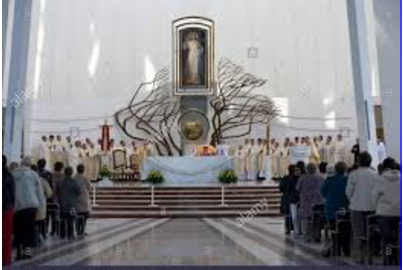
The main altar of the Divine Mercy Shrine in Krakow during the Holy Sacrifice of the Mass.
       Divine Mercy and the Eucharist. In paragraph 1447 Christ expresses His love in Holy Communion. “Oh, how painful it is to Me that souls so seldom unite themselves to Me in Holy Communion. I wait for souls, and they are indifferent toward Me. I love them tenderly and sincerely, and they distrust Me. I want to lavish My graces on them, and they do not want to accept them. They treat Me as a dead object, whereas My Heart is full of love and mercy. In order that you may know at least some of My pain, imagine the most tender of mothers who has great love for her children, while those children spurn her love. Consider her pain. No one is in a position to console her. This is but a feeble image and likeness of My love.”
       Some History. For years the Vatican would not approve the visions of Sister Faustina, who died in 1938, as worthy of belief.   In fact they suppressed her writings and put her work on the Index of Forbidden Books from 1959-1966. As God's providence works, a young Karol Wojtiła was working at a quarry near the convent during the German occupation in the early 1940s and learned about Faustina from the nuns when he visited their chapel.

      By 1963 this youth became the Archbishop of Krakow. He investigated the visions and Faustina's writings and interviewed witnesses, becoming convinced of her holiness and the authenticity of the revelations and her writings. Theologians were amazed how a simple woman with only a third grade education could write a book with such profound depth. In 1967, the year he was made Cardinal, Wojtiła submitted documents about Faustina to the Vatican, requesting that the process of her beatification begin and it did in 1968. In 1977 he asked the Vatican to review and lift the ban on the Divine Mercy devotion. The Prefect of the Sacred Congregation for the Doctrine of the Faith lifted in April 1978 a few months before he was elected Pope in October. The misunderstandings were all due to a faulty translation into Italian.
St. Faustina with the original image of Divine Mercy by Kazimierowski.

       After being elected Pope in 1978, his second encyclical was on Divine Mercy titled, Dives in Misericordia (The Father of Mercies and God of all Comfort) November 30, 1980 and her cause for canonization was opened. In 1993 Pope John Paul beatified her and on April 30 2000, the First Sunday After Easter, he canonized her as a saint of the Catholic Church.......the very first of the new millennium. In his homily of that Mass, the Pontiff declared the First Sunday After Easter as Divine Mercy Sunday throughout the world according to the request of our Lord to St. Faustina, close to 70 years before.
          Divine Mercy Sunday and Special Graces. One may obtain special graces by saying the Divine Chaplet for nine consecutive days beginning Good Friday with a different intention and prayer each day as follows: 1) All mankind, especially sinners; 2) The souls of priests and religious; 3) All devout and faithful souls; 4) Those who do not believe in God and those who do not yet know me; 5) The souls of separated brethren; 6) The meek and humble souls and the souls of little children; 7) The souls who especially venerate and glorify my mercy; 8) The souls who are detained in Purgatory; 9) Souls who have become luke-warm.
        Anyone who receives Holy Communion on Divine Mercy Sunday and goes to Confession within three weeks of that day will receive a plenary remission of temporal punishment in Purgatory.
         Our 1995 Visit. At that time Divine Mercy was relatively unknown. I learned about it when I taught at Franciscan University of Steubenville 1980-83. During my first visit to see Jaga's family, I asked to see the Shrine of Divine Mercy. To my surprise hardly anyone knew anything about it. True, Communism had been overthrown only six years before, but they did have a relative freedom of worship, but very limited freedom of religion where the Church could freely build churches, have their own newspapers, schools, minimal government interference, etc. A coworker of Janusz, my sister-in-law's husband, said it was in the Łagiewniki section of Krakow. We went there and had to ask several people before one could tell us where it is.
The old convent with the original chapel in which our Lord appeared to St. Faustina

        Finally, we found this old walled convent by trial and error and asking people who did know as we got closer. As we entered, we saw a large open air theater for Masses on Divine Mercy Sunday some five or six thousand people would come. We found the chapel and was on time for the Mass at 3 pm, the hour of grace when Christ died. The chapel only has room for some 150 people; so many had to stand outside. The artist Adolph Hyla's conception of Christ, as described by St. Faustina, looked stunning over a small altar to the left of the main altar.
        Fascinating was the story of the shrine by a nun from Texas, of all places. In the 1980s she was on a tour of Polish shrines. A priest in the group asked the Communist guide to take the group to the Shrine of Divine Mercy. He didn't know where it was, but they did find it. This young woman returned to the United States enthralled by the Shrine and the Divine Mercy message. After a few months, the Texan was convinced she had a vocation to the Polish order. Thus this girl from Texas joined the order and learned Polish, which she spoke very well.
       Much of what we learned from her is described in this article. One story concerns the time when a beggar knocked at the door of the convent. St. Faustina gave him some food and later Our Lord revealed that He was the beggar. This certainly reinforces what Christ said during His public life “Whatever you did for one of these least brothers of mine, you did for me” (Matthew 25:40).
        Christ revealed to St. Faustina that if there is even a glimmer of good will in a dying person, He would try to take advantage of it. So this American had to tell our Polish relatives about the fabulous Shrine of Divine Mercy three hours away from them.
The final stop for 6 million Jews as St. Edith Stein and also gentiles
such as the Polish priest St. Maximilian Kolbe.  The Nazis were merciless.


         1999. We stopped at the shrine after we visited Auschwitz, a very somber visit. Some 6 million people were exterminated there, mostly Jews but a significant number of Christians. There was heroism there too as when St. Maximilian Kolbe gave his life so another prisoner could live. St. Faustina foretold that war. As I reflected at the monument there, a terrifying thought entered my mind: “What about our Holocaust? Hitler killed 10 million Jews; we killed 53 million babies since the legalization of abortion in 1973. Our country is indeed in great need of the Lord's mercy! This visit was brief and we heard Mass late in the afternoon. At this time, they were raising money for the new basilica and that year began construction.
         2007 and 2008. While teaching in Kielce during the Spring Semesters of both years, I had the opportunity to visit the shrine on Divine Mercy Sunday by bus. Each time there was a throng of over 50,000 people gathered in a field below an outside altar to the right of the Basilica. Cardinal Stanisław Dziwisz presided at the open air Mass each time. He was the secretary and confidant of Karol Wojtila as Archbishop of Krakow and as Pope John-Paul II.
  
    The Basilica of the Shrine of Divine Mercy is of modern architecture and beautiful with a tower overlooking the convent grounds and the surrounding countryside. The view is great. The original convent and chapel are the red brick buildings in the background. 
        Once Pope John Paul II canonized St. Faustina and declared the Sunday after Easter as Divine Mercy Sunday, the Divine Mercy devotion grew rapidly. Today everyone in Poland has heard of the Divine Mercy Shrine. Today every Catholic Church in the world celebrates Divine Mercy Sunday. Almost every church in Poland and many in the United States have an image of Divine Mercy.
        God's Mercy in the Bible occurs many times in the Bible as early as Exodus 20:6; 1Samuel 12:7; 1Chronicles 21:13; 2Chronicles 5:13; Hosea 6:6; in the psalms and throughout the New Testament as Matthew 5:7; 9:13; 12:7; 23:23; Luke 1:50,54, 58,72,78; 10:37; 18:9-14, etc. The Prodigal Son and the Good Samaritan are excellent examples of mercy.  A little study will show that there is no contradiction between the Bible and the Diary of St. Faustina, i.e. Divine Mercy in My Soul.  In fact, it reinforces the Bible.