Friday, June 22, 2012

(86) St. Thomas More & St. John Fisher: Their Inspiration for Freedom of Religion Today

AMDG

      In 2010, speaking to a group of priests, Cardinal Francis George said, “I expect to die in bed, my successor will die in prison and his successor will die a martyr in the public square. His successor will pick up the shards of a ruined society and slowly help rebuild civilization, as the church has done so often in human history.”[12]  - See more at: 

        With our country on an expressway to Sodom and Gomorrah those words of Cardinal George may indeed come true.  Thus our young men and women should study the lives of St. Thomas Moore and St. John Fisher who are becoming more relevant than ever almost 500 years later as models of courage and integrity when the rest of their society just went along with the flow.  In the years after their deaths the Catholic Church in England suffered one of the most violent and gruesome persecutions in world history. 


       St. John Fisher was the Bishop of Rochester and at the same time St. Thomas More was a layman serving in the government of King Henry VIII as Lord Chancellor (Prime Minister).  Both fought for religious freedom for the Church and its members to faithfully practice the faith in opposition to the tyrannical dictates of King Henry VIII.  They were both beheaded in 1535 and the two friends were canonized together 400 years later by Pope Pius XI on May 19, 1935.  Both have their feast days on June 22.  They beautifully exemplified the Church and the laity working together.  Both of them, men of principle and integrity, refused to bow to expediency and what was politically correct at the time. They did what was right despite the consequences.  Government officials, politicians, and Church leaders can learn so much from them.  

       Preceding them almost 400 years earlier was St. Thomas Becket (1119 – 1170), who was murdered after confronting King Henry II over his attempt to dominate the Church and violate its freedom and rights.   Thomas More (1478 - 1535) was born within a few hundred yards of the birthplace of his heroic patron saint and was beheaded in the same year as St. John Fisher for essentially the same reasons.  All three English martyrs died for freedom of conscience and for Church freedom…….not simply freedom to confine its worship within the four walls of a church, but also the freedom to be faithful to church teaching in the public sphere and to speak up in its defense.  The two English saints martyred in 1535 also died in defense of the institution of Marriage as Christ had ordained.

         We can learn from them to love our Country, but distrust the Government.  The Fortnight for Freedom from June 21 to July 4 is an annual period of prayer for not only freedom of worship, but also freedom of religious practice where Catholic employers would not be forced to provide medical insurance under the Department of Health and Human Services (HHS) Mandate that includes contraceptives and abortifacients; to have the freedom of conscience to not perform actions on the job contrary to Church teaching as declining to participate in abortions or the administration/sale of abortifacients; for Catholic charities to have the right to exclude homosexual couples from adoptions; to freely hire people that concur with the organization's mission and values; for Catholic businesses to refuse to provide goods or services for gay marriages and their celebrations; the right to voice and bear witness to the truth even if it is unpopular or considered to be politically incorrect in classrooms or public forums.

ST. JOHN FISHER:  A FIGHTER FOR THE INSOLUBILITY OF MARRIAGE

      St. John Fisher (1469 -1535) was an eminent scholar and a brilliant theologian.  He studied Theology at Cambridge and later taught there, becoming its Chancellor, president of one of its colleges, and the Cardinal Bishop of Rochester.  He was an effective and prominent spiritual shepherd, leader, and administrator in all of these posts, but still found time to write several books to refute the errors of the day.  A humble man, he led an austere life.

St. John Fisher
      Although once the tutor of King Henry VIII, St. John Fisher in conscience had to oppose his divorce of Catherine of Aragon and subsequent marriage to Ann Bolyn.  After oath of allegiance to the King as the Head of the Church in England, called the Oath of Supremacy and Act of Succession recognizing the remarriage and succession of his children with Ann Bolyn to the throne in opposition to papal authority, the king imprisoned him for “treason”.  When the Pope made John Fisher a cardinal, the angry king had him beheaded at the age of 66,

       His friend, St. Thomas More said of him: “In this realm no one man, in wisdom, learning, and long approved virtue together, meet to be matched and compared with him.”


ST. THOMAS MORE: TRUE MAN OF GOD & INTEGRITY FOR TODAY

Thomas More (1478 - 1535) was born within a few hundred yards of the birthplace of his heroic patron saint, Thomas Becket (1119 – 1170), who was murdered after confronting King Henry II over his attempt to dominate the Church and violate its freedom and rights.  Thomas More was a very learned  lawyer and a scholar, a holy man with a deep prayer life which included daily Mass as an altar server.  

     Thomas More was a statesman.......Speaker of the House of Commons of Parliament.  Later he was a counselor (adviser) to King Henry VIII who appointed him as Lord Chancellor (Prime Minister). However, More resigned that position and retired from public life because he could not approve of the divorce of Catherine of Aragon and remarriage to Ann Bolyn.  More was actually ahead of his time in regard to peaceful means of settling disagreements among countries.  In fact he advocated constructing an agreement to make war unnecessary.
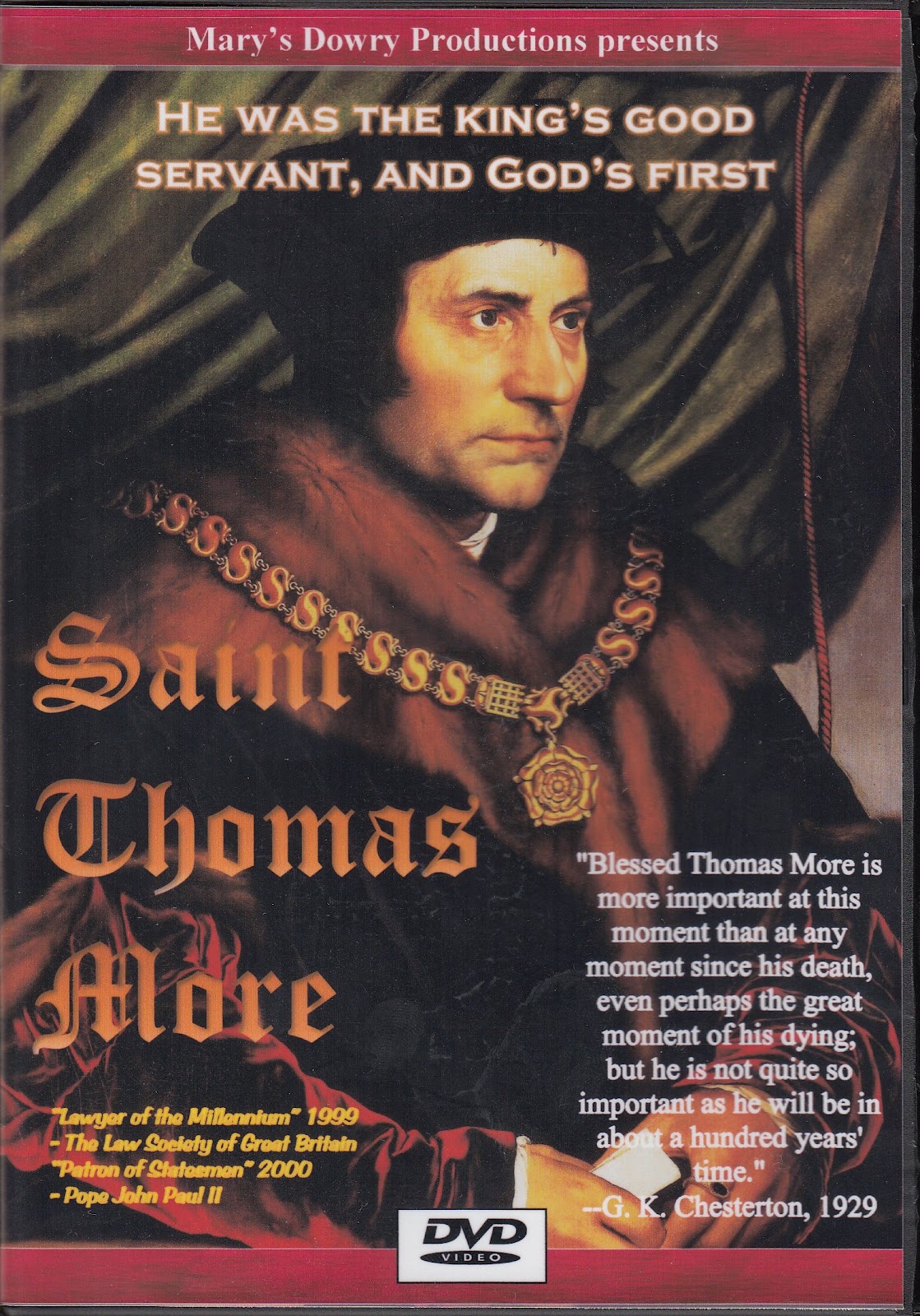
         Thomas More wrote the novel, "Utopia" and a history of Richard III among others which inspired a Shakespearean play.  He was a staunch defender of the faith in a half million word volume, "The Confutation" against William Tyndale and other writings against Martin Luther and the Protestant Reformation.


St. Thomas More loved his family.  He enjoyed them at Chelsea, his country estate built in 1524.  After his first wife died, More married again.  He educated his daughters, which was unusual for the time.          
        King Henry VIII at first defended the faith against Martin Luther, who rebelled against the Catholic Church and formed his own church.  In response he attacked his critic, Henry VIII in print, calling him a “pig, dolt, and liar”.  Apparently such name calling was more acceptable then than now. At the request of Henry VIII, Thomas More set about composing a rebuttal.  The resulting Responsio ad Lutherum  (Latin was the international language of the day) was published at the end of 1523. In the Responsio, More defended the supremacy of the papacy, the sacraments, and other church traditions. More’s language, like Luther’s, was virulent, and he branded Luther as an “ape”, a “drunkard”, and a “lousy little friar” among other insults.  This shows that Thomas More had his faults and was, like all of us, a saint under construction until his death 12 years later.
Thomas More was a close friend and confidant of King Henry VIII.  He was always loyal to the King in temporal matters, but loyal to the Pope in spiritual and Church matters.  Thus he could not recognize the King's supremacy as the head of the Catholic Church in England nor recognize the divorce of the King's first wife, Catherine of Aragon.  When Henry VIII separated the Church of England from Rome, St. Thomas More opposed it.  Furthermore, he refused to take an oath accepting the First Succession Act which recognized the daughter (Elizabeth) of his second wife as the successor to the crown over Mary, the daughter of his divorced first wife. 
Refusing to sign a statement of allegiance to the King as the Head of the Church in England, called the Oath of Supremacy, despite pressure from his wife and four children to yield, he was imprisoned and later executed at the age of 57 in the Tower of London fourteen days after his friend, Bishop John Fisher for similar reasons.  From prison, St. Thomas More wrote letters of consolation to his family and other spiritual works such as: "I will not mistrust God, though I shall feel myself weakening and on the verge of being overcome with fear.  I trust God shall place a holy hand on me and in the stormy seas hold me up from drowning".  

      A man of great wit, he jokingly told his executioner in a friendly way to be careful not to cut his beard.  Just before being beheaded, he said: "I die as the King's loyal servant, but God's first."  St. Thomas More did what was right no matter what rather than bow to convenience and what others did.......including nobles, bishops, priests, etc.     
More was greatly admired by Anglicans as writers Jonathan Swift and Samuel Johnson. Johnson said that ""He was the person of the greatest virtue these islands ever produced".  St. Thomas More was a man of good will, honor, and integrity......true to his principles.  He had a sense of justice, fair play, and conscience. Winston Churchill wrote about Thomas More in the "History of the English-Speaking Peoples": "The resistance of More and Fisher to the royal supremacy in Church government was a noble and heroic stand. They realized the defects of the existing Catholic system, but they hated and feared the aggressive nationalism which was destroying the unity of Christendom".   

      What a model for all of us, especially lawyers, politicians, government officials, administrators, managers, and leaders in general!  He did what was right despite the consequences.  In 1966, St. Thomas More's life inspired the hit Academy Award winning movie: "A Man For All Seasons", available at amazon.com.
         Under Queen Elizabeth I and her successors, persecution of Catholics was so intense, that any Catholic priest found, was dismembered by a team of horses and his impaled head was placed at one of the London bridges.  There is considerable evidence that Henry Shakespeare was an undercover Catholic. Faithful seminarians and priests had to be educated abroad.  They came back to minister, often to their deaths. It wasn't until 1793 that religious freedom to Catholics was restored.  It was miraculous that the Church survived against all odds and today in Britain it is stronger that the Anglican Church.  The Basilica of St. Mary of the Assumption in Marietta has a special chapel dedicated to the English Martyrs to the extreme right of the main altar near the exit.  See www.stmarysmarietta.org/ and Blog #135 at paulrsebastianphd.blogspot.com.


Thomas More was canonized by Pope Pius XI on May 19, 1935 and named the patron saint of lawyers, which includes politicians.  He could have been canonized a saint without having been martyred.  From an early age, he strived for holiness.  He even joined the Carthusian Order to test a possible vocation, but after a while decided to follow in the footsteps of his father as a public figure and have a family.  Despite being Chancellor (Prime Minister), he wore a hair shirt as penance and woke up at 2 am each day to pray in the Carthusian tradition.  As prisoner in the Tower of London, he lived the life of a monk in prayer, reading, and writing.  For all of that he was grateful to King Henry VIII.  He even wrote a prayer asking for forgiveness and mercy for his enemies.  He actually hoped to share the joys of Heaven with Henry VIII.

APPENDIX: Prayers and Quotes Attributed to St. Thomas Moore

Prayers that this saint composed give insights into the character and holiness of St. Thomas More as a True Man of God.
-Grant me, O Lord, good digestion,
and also something to digest.
-Grant me a healthy body, and
the necessary good humor to maintain it.
-Grant me a simple soul that knows to
treasure all that is good and that
doesn’t frighten easily at the sight of evil,
but rather finds the means to put things
back in their place.
-Give me a soul that knows not boredom,
grumblings, sighs and laments,
nor excess of stress, because of that
obstructing thing called “I.”
-Grant me, O Lord, a sense of good humor.
-Allow me the grace to be able to take a joke
to discover in life a bit of joy,
and to be able to share it with others.

Give Me the Grace, Good Lord
-To set the world at naught. To set the mind firmly on You and not to hang upon the words of men's mouths.

-To be content to be solitary. Not to long for worldly pleasures. Little by little utterly to cast off the world and rid my mind of all its business.

-Not too long to hear of earthly things, but that the hearing of worldly fancies may be displeasing to me.

-Gladly to be thinking of God, piteously to call for His help. To lean into the comfort of God.  Busily to labor to love Him.

-To know my own vileness and wretchedness.  To humble myself under the mighty hand of God.  To bewail my sins and, for the purging of them, patiently to suffer adversity.

-Gladly to bear my purgatory here. To be joyful in tribulations. To walk the narrow way that leads to life.

-To have the last thing in remembrance. To have ever before my eyes my death that is ever at hand. To make death no stranger to me.  To foresee and consider the everlasting fire of Hell. To pray for pardon before the judge comes.

-To have continually in mind the passion that Christ suffered for me. For His benefits unceasingly to give Him thanks.

-To buy the time again that I have lost. To abstain from vain conversations. To shun foolish mirth and gladness. To cut off unnecessary recreations.

-Of worldly substance, friends, liberty, life and all, to set the loss at naught, for the winning of Christ.

-To think my worst enemies my best friends, for the brethren of Joseph could never have done him so much good with their love and favor as they did him with their malice and hatred.

-These minds are more to be desired of every man than all the treasures of all the princes and kings, Christian and heathen, were it gathered and laid together all in one heap.  Amen

Quotes on the Wall of the St. Thomas More Newman Center of the Ohio State University

           Lord, Grant Me a Holy Heart
-Lord, Grant Me a Holy Heart that sees always what is fine and pure and is not frightened at the sight of sin, but creates order wherever it goes
-Grant me a heart that knows nothing of boredom, weeping and sighing.
-Let me not be too concerned with the bothersome thing I call “myself”.
-Lord, give me a sense of humor and I will find happiness in life and profit for others.


Short Quotes Attributed to St. Thomas More

§  Happy is the person who can distinguish between a rock and a mountain--- it avoids so many inconveniences.

§  There is never a pilgrim who returns home without one less prejudice and one new idea.

§  I die the king’s good servant, but God’s first.

§  These things good Lord that we pray for, give us the grace to labor for.


Not a Post - Will Put a Past Family Newsletter


Monday, May 28, 2012

(84) Meditations For the Rosary IV: The Glorious Mysteries

  AMDG


A painting by Raphael (1483-1520)

The 20 mysteries of the rosary and their corresponding meditations cover the highlights of the life of Christ and His mother, Mary. Four times through this liturgical year, we have published meditations on a set of five mysteries 1)Joyful, 2)Luminous, 3)Sorrowful, and 4)Glorious that coincide with the Gospels of the liturgical year.  Since the rosary is very biblical, bible references follow each meditation.  As to the repetitive background prayer, the Our Father’s is the prayer the Lord Himself gave to us and the Hail Mary prayer comes from Luke 1:28, 42. At the end of each decade, we give glory and praise to the Holy Trinity……the Father, the Son, and the Holy Spirit.  We don’t adore Mary, but rather we honor her as a model and ask her to pray for us.
        
     Conceptually, the rosary is a litany of repetitive prayers, which act like background music, while the focus is to meditate upon five of 20 different mysteries of the life of Christ and His mother, grouped according to the joyful, luminous, sorrowful, and glorious events portrayed or alluded to in the Bible. See  www.americaneedsfatima.org

    The rosary is said with the aid of beads and a connected crucifix, marking the beginning with the Apostles Creed. This is followed by an Our Father for the intentions of the Holy Father, three Hail Mary prayers for the increase of Faith, Hope and Charity plus a Glory Be. Then each decade or mystery includes one Our Father, ten Hail Marys, and a Glory Be (Praise), really a profession of faith.  Please permit me to share insights I obtained from many sources and use while meditating on the holy rosary. You might like to incorporate some of these meditations among yours or add to them.   

        For those who say the rosary every day: The Joyful Mysteries are usually said on Monday & Saturday; the Luminous Mysteries are said on Thursday; the Sorrowful on Tuesday and Friday; and the Glorious on Wednesday and Sunday. The Sunday rosary may use instead the mysteries that correspond to the season of the liturgical year.......Advent, Christmas, Lent, and Easter. The Sorrowful Mysteries are usually said during the entire Holy Week and the Glorious Mysteries are usually said for the entire Easter Week. Of course one may meditate on any set of mysteries. There's no rigid rule.

 “The family that prays together, stays together.” This was the theme promoted by Fr. Patrick Peyton on his Family Theater program on radio and television during the 1940s, 50s, and 60s. He recruited the top movie stars of the day (Jimmy Stewart, Gregory Peck, Bing Crosby, Bob Hope, Loretta Young, etc. and even a young actor by the name of Ronald Reagan) as volunteers to sing or act in inspiring dramatizations on his Family Theater program on radio and television.  Available on DVD is a movie on the Life of Christ which he produced.  Fr. Peyton, the Rosary Priest, promoted the rosary all over the world in talks and rallies. 

    His cause for canonization is advancing.  Go to https://www.youtube.com/watch?v=LXFlEJIpkqQ for one of Fr. Peyton's messages and links to other clips of his productions.  Learn more about this future saint by clicking on http://www.fatherpeyton.org/ and http://www.hcfm.org/FatherPeyton.aspx.  The latter has a link to the online store of the Holy Cross Family Ministries for a wealth of DVDs, books, and other resources regarding his work and the work of his order.
  
In gratitude for his lifetime work Pope John Paul II embraces Fr. Patrick Peyton, the Rosary Priest.

        Prayer has healed millions, ended wars, overthrown dictators, decisively stopped the advance of militant Islam into Europe at least three times at Belgrade in 1456, Le Panto in 1571, and again in breaking the siege of Vienna by the Turks in 1683, each a chapter in a one thousand year old war between Western Civilization and Radical Islam that includes today's War on Terror.  Otherwise, Europe would be a lot different today.

IV. THE GLORIOUS MYSTERIES OF THE ROSARY

            During the Glorious Mysteries, imagine that you have gone through a time capsule and you are there at the tomb during the Resurrection of Christ on the first Easter Sunday, you are with the apostles during His appearances to them; saying good-by to Jesus as He ascends into Heaven; and being filled with the Holy Spirit on the first Pentecost, on fire helping with the many conversions on that day.  
    
        Then we are with the apostles saying good-by to Mary during her dormition, her beautiful death or falling asleep as she is taken or assumed into heaven (body and soul) to be physically reunited with her son before being crowned Queen of Heaven and Earth.  The facts of the Glorious Mysteries of the Rosary are based on the Bible and tradition handed down by the apostles as seen in the writings of the early Church fathers.
  
        Below are meditations for each decade or mystery. One may use the entire meditation or read and reflect only upon the Bible passages as he or she can imagine being there as an observer. In bold is a recommended shorter version when time is limited. Anything in italics is a quote taken directly from the Bible.
The First Glorious Mystery: The Resurrection


       Over the weekend of Good Friday, there was despair among the disciples who put their hopes and trust in their Master, but to their surprise.......HE IS RISEN as He truly said he would. Alleluia! That gave credibility, validation, and vindication to Christ's to His teachings and His saying that He is the Son of God. Without the Resurrection, Christ would go down in history as just another good man or just another prophet who was killed for what He believed.  

      By His resurrection, Christ conquered death, evil, and sin.  God made good come out of evil.  Since Our Lord rose again victorious, we also have the hope of rising again victorious and achieving everlasting happiness with Him in heaven.  No matter how difficult are the crosses we must bear on earth, we can accept and unite them with His cross, TRUSTING that our crosses will make us saints and OUR VICTORIOUS RESURRECTION WILL COME.  All that remained in the tomb was the shroud wrapping the body of Christ.  At the instant that Christ's soul gloriously reentered His body, there was a burst of radiation that scorched the shroud just enough to leave on it an image of the crucified Savior that He left for us to strengthen our weak faith.

       Other options include reading and reflecting during the recitation of this decade on Psalm 16:5-11; Jeremiah 20:10-11; Matthew 16:21-22; 17:22-23; 20:17-19; 27:57-28:15; Mark 15:42-16:13; Luke 23:50-24:48; John 2:19-22; 19:38-21:25; Acts 1:1-3, 21-22; 2:30-32; 4:33; 10:39-43; Romans 1:1-3; 6:3-14; 1Corinthians 15:3-8, 12-22; 1Peter1:18-21. 

The Second Glorious Mystery: The Ascension


The eleven apostles went to Galilee, to the mountain to which Jesus had ordered them to go.  When they saw him, they worshiped, but they doubted.   Then Jesus approached and said to them, "All power in heaven and on earth has been given to me.  Go, therefore, and make disciples of all nations, baptizing them in the name of the Father, and of the Son, and of the Holy Spirit, teaching them to observe all that I have commanded you.  And behold, I am with you always, until the end of the age"  (Matthew 28:16-20).  Christ meant that not only for His apostles, but also for us to evangelize in little or big ways by prayer, by example and witness, by word, and by deed in our daily lives.......be it in the home, in parish functions or apostolates, in the community, in conversation, and even on the job.  

        He promised to always be with us, particularly in the Eucharist.  At the same time our Savior “is seated at the right hand of God, the Father almighty; from there he will come to judge the living and the dead.”  The apostles were sad to see their Master depart and now had to wait to be filled with the Holy Spirit (confirmed) to begin their great mission of evangelization.  Other options include reading and reflecting during the recitation of this decade on Mark 16:14-20; Luke 24:47-53; and Acts 1:6-12.   

The Third Glorious Mystery

 The Descent of the Holy Spirit

       Present were Mary and the apostles....... “When the time for Pentecost was fulfilled, they were all in one place together.  And suddenly there came from the sky a noise like a strong driving wind, and it filled the entire house in which they were.  Then there appeared to them tongues as of fire, which parted and came to rest on each one of them.  And they were all filled with the Holy Spirit and began to speak in different tongues, as the Spirit enabled them to proclaim” (Acts 2:1-4). 

    May the Holy Spirit renew in us the graces and His gifts of the sacrament of Confirmation as well as His fruits.  As soldiers of Christ, may we be always faithful to the Lord and His Church.  As were the first apostles, may we also be fearlessly on fire for the faith......to defend it, to spread it, and to share it with others no matter the cost.    Dear Holy Spirit, always tell us what to do, what to say, and what to write.  Other options include reading and reflecting during the recitation of this decade on Psalm 2:1-7; 104:30; 118:1-9,19-29; Ezekiel 37:14; Joel 3:1-5; Mark 16:14-20; John 3:5-8; 7:37-39; 14:15-28; 15:26-27; 20:19-23; Acts 1:4-5; 2:1-41; 3:12-26; 4:5-14; 23-31; Romans 8:22-27; 1 Corinthians 12:3-13; Galatians 5:13-26; 1 Peter 1:10-12.


The Fourth Glorious Mystery: 
The Assumption of Mary into Heaven

                                                    
        According to tradition, the apostles joyfully found only the most beautiful flowers where Mary previously laid in state.  Christ followed the 4th Commandment in honoring His mother by having her body and soul taken directly into His arms in Heaven.  Our Lord would not allow her body, a living tabernacle for nine months, the new Ark of the Covenant, to deteriorate in the earth. 

        Mary’s womb, the new Ark, did not contain manna, but the Bread of Life which is the Eucharist, Christ Himself.....not the staff of Aaron, but the Good Shepherd and High Priest who will offer Himself for us…..not the Ten Commandments, but the Son of God, who will speak for the Father.

        All of Heaven received Mary with immense joy.  Mother Mary, pray for us so that we may have a happy death as you had.  Other options include reading and reflecting during the recitation of this decade on Judith 13:18; Luke 1:39-56; 11:27-28; 1 Corinthians 15:20-27, 54-58; 1 Thessalonians 4:14-17; Revelation 11:19; 12:1.


The Fifth Glorious Mystery: 
The Coronation of Mary as Queen of Heaven & Earth


Imagine that you are there with all Heaven rejoicing in jubilation as Mary is gloriously crowned Queen of Heaven and Earth by her Son and the Father with the Holy Spirit looking on.   In the tradition of the Old Testament, the Queen Mother of Christ the King of the universe took her place of special honor and influence in the heavenly court.  From there our mother continues to intercede and pray for us and the world. 

Other options include reading and reflecting during the recitation of this decade on Judith 15:9-10; Revelation 12:1-6.  For meditations on the Joyful, Luminous, Sorrowful, and Glorious Mysteries of the rosary go to Blogs # 50, 73, 78, and 84 at paulrsebastianphd.blogspot.com.


Monday, May 21, 2012

(83) The Role of Mary in the Church


  AMDG
               

The beautiful month of May is special in giving a temperate preview of summer as the Spring flowers are in bloom.  Since the Church dedicates this month to Mary, let us examine her role in the Church.  

            One of the biggest problems for prospective converts besides the Eucharist is Mary.  But she should not be.  We don't worship her.  We honor her as we honor any other hero of our country.  Yes, we do ask her to pray for us the same as I would ask you to pray for me and for the success of our Newman Club even though we all believe that there is only one mediator between God and man.  Millions over the centuries flock to the many great and often magnificent churches or shrines, full of art such as Notre Dame in Paris and Chartres France, to honor Mary, to ask for her help through her prayers to God, and for her motherly nurturing.  The United States has in its capital, Washington D.C. the magnificent Shrine of the Immaculate Conception of Mary, its patroness.  The basilica took years to build.  

             Any devotion to her is optional.  However it is considered as Church doctrine and required belief that she was immaculately conceived without the stain of  original sin and that she was bodily assumed into Heaven as we will be at the Last Judgment.  Since her womb was the first tabernacle and the new Arc of the Covenant that carried God Himself, it is only logical that God would create her without original sin and would not let her body deteriorate in the earth.  This is based upon Church tradition handed down by the apostles, but not recorded in the Bible.  The writings of the early Church Fathers of the first three centuries do mention her.  They refer to Mary as the new Eve who said yes to God at the Annunciation by the Angel Gabriel (See http://principiumunitatis.blogspot.com/2009/11/early-church-fathers-on-mary-as-new-eve.html  and http://www.staycatholic.com/ecf_immaculate_conception.htm). 

            Mary's role in the Church is to nurture the Faith, to bring us closer to her Son, and to help us to follow Him and His teachings.  We see some of this at Cana in the Gospel of John 2:5 where Mary instructed the chief steward:  “Do whatever He tells you”.  After all the role of a mother is to nurture and she is our mother whom Christ gave to us from the cross before He died.  After giving Himself in the Eucharist on Holy Thursday and while redeeming us on Good Friday, He gave us His mother with the words Woman, behold your son” and to St. John by his own testimony, “Behold your mother” John:26-27).

            The Immaculate Heart and the Sacred Heart are in such intimate union, that she would only do the will of her son.  She has no power in herself.  Any power that she might have, is given to her by God to carry out His will.  She is completely dependent upon Him.  Mary is like the moon and in reflecting the light of the Son.  Examples of her nurturing are through her apparitions and resulting shrines.  There are hundreds of claimed apparitions, but relatively few are approved by the Church as worthy of belief (See http://www.catholicdoors.com/isit/approved.htm).  However, Catholics are not required to believe any of them.
 
            Lourdes.  The Catholicism Series only mentions the shrines of Guadalupe, Fatima, and Lourdes, where thousands of healings have occurred.  However, only about 75 have passed the strict scrutiny of the Church (a panel of doctors) as being beyond human explanation.  Among the thousands of sick who go there for healing, a significant number are actually healed physically, but almost all of them undergo a certain healing of soul.  They become closer to God and are better able to cope with their great crosses.  Any miracle, used to support the beatification or canonization of a saint as a sign from God that he or she is a person of extraordinary holiness and heroic virtue, must pass the same scrutiny.

            At the Shrine of Our Lady of Guadalupe in Mexico City over the main altar of the Basilica is the miraculous image which appeared on the tilma of Juan Diego when he presented the roses that Mary sent to the Bishop as the requested sign.  The image is full of symbols that only the Aztecs understood as a message that they should follow the religion of the Spaniards.  In a few years 8 million Indians converted to the faith, replacing all of those lost to Protestantism during the Reformation.  Thus Mary is the greatest missionary of them all.  The sash Mary is wearing indicates that she is pregnant.  Thus Mary has been designated as the "Patroness of the Unborn".  The fact that the Aztecs then stopped making human sacrifices of adults, children, and babies to their pagan gods connects her intimately to the Pro-life Movement.  See my blogs #104, 105, and 106 for more detail. 
 
            Is the Hail Mary prayer biblical?   Absolutely.  “Hail Mary full of grace, the Lord is with thee” (Luke 1:28 in the Annunciation).  Blessed art thou among women and blessed is the fruit of thy womb (Luke 1:42 in the Visitation).  Were the Angel Gabriel and St. Elizabeth worshiping Mary?  Obviously not.  The second part of the prayer continues:  “Holy Mary, mother of God, pray for us sinners now and at the hour of our death amen”.  Clearly, the prayer first honors Mary and then asks her to pray for us, not worshiping her at all.  She was overshadowed by the Holy Spirit the same as God in the cloud overshadowed the Arc of the Covenant of the Israelites during the sojourn in the desert.   In Christ, the human and the divine come together.....true God and true man  Thus Mary is indeed the Mother of God, i.e., the human nature of Christ.
   
           There are only two religions in history that have placed a woman in such high esteem......the Catholic Faith and the Orthodox which broke away in 1054.

         Fatima.  Interesting is that the Qur’an devotes the entire chapter 5 to Mary as the most perfect woman that God ever created (See http://campus.udayton.edu/mary/QuranAndMary.htm).  Also interesting is the Muslim source, http://www.mostmerciful.com/jschinqr.htm  Fascinating is the fact that when the Moors conquered and occupied most of Spain and Portugal, the Muslims named a small Portuguese town, Fatima, after Mohammed’s favorite daughter, Fatimah.  It was no accident that Mary chose that little village as the place of one of her most famous apparitions to three shepherd children in 1917.  Is Mary reaching out to Islam?  

          At Fatima Mary said that World War I would soon end, but if the world did not repent, there would be a  worse world war; Russia would continue to spread its errors; and there could be even a third world war.  That was before the Russian Revolution.  Shortly before the start of World War II there would be “a night illumined by an unknown light”.  My blog #95 has a clipping from the London Times of January 27, 1938 that documents it and that same blog has other photos and explanations in regard to the apparition.

            The Rosary.  Mary asks us to pray the rosary to bring us closer to God.  The repetitive prayer serves as background music while the focus is on meditating on either the Joyful, Luminous, Sorrowful, and Glorious Mysteries in the life of Christ and Mary, almost all of which is Biblical.
 
            Thus we can see the truth in the old Catholic saying:  “To Jesus through Mary”.


Wednesday, May 2, 2012

(82) National Day of Prayer: Prayer for the Military and Veterans Still Hurting


       The National Day of Prayer has been an annual observance since 1952 when Congress officially established it.  Every year the President of the United States and most state governors issue proclamations on or prior to the first Thursday of May.  People all over the United States are asked to assemble at noon on the first Thursday of May at their county court houses to pray for our Country.  If that is not possible or inconvenient, then people are asked to at least pause for a minute or two at noon to pray.  God knows how much our Country needs prayer.

        It has been observed at the University of Rio Grande in southeastern Ohio since 1998.  Faculty, staff, students, and guests meet at the gazebo between the Bookstore and the cafeteria to pray for our country.  

 PRAYER FOR THE MILITARY AND VETERANS STILL HURTING
Given in Observance of the National Day of Prayer at the University of Rio Grande 26 April 2012, 23 April 2015, 25 April 2016.
Published in the Gallipolis Daily Tribune on Tuesday, November 11, 2012 for Veteran's Day.

O Lord, we beseech thee first and foremost to grant us Peace in Afghanistan, Iraq, Syria, and the world. Because war is hell, all good soldiers must yearn for Peace, the ultimate goal in which lie their own personal aspirations and the aspirations of the entire Country.

Purify the motives of every soldier to be aware that the ultimate mission of the military in defending our Country is to achieve peace through victory while preserving human dignity to the greatest extent possible....... combatants and non-combatants, friend and foe.......all as children of God.

Protect our troops who are in harm's way.........from enemy and even friendly fire, IEV's, ambushes, and accident.

Guide our NCOs and commissioned officers to lead effectively and to accomplish the mission with prudence and wisdom while caring for their men and women without risking their lives unnecessarily. Remind them to seek your counsel in the life and death decisions they must make.

Remind our men to look out for each other as they all strive to survive in the heat of battle.

Maintain the morale of the troops. Preserve the patriotic and spiritual ideals of our young men and women, their sense of moral right and wrong so that they do not become cynical as they live through the horrors of war while fighting for our Country.

Help our soldiers to treat prisoners of war with dignity as human beings and even with a certain compassion despite the fact that the enemy may have committed monstrous atrocities upon their buddies. Don't let us ever lower ourselves to seek revenge with atrocities of our own.

Inspire our troops to also work for the common good of all........to be effective ambassadors of good will, and win the hearts and minds of the people while accomplishing the mission.

Make our officers ever aware of the consequences of their decisions upon people in regard to the safety of their troops and collateral damage to the populace.......to be prudent in not using more force and causing more destruction and casualties than is necessary to accomplish the mission.

Give our troops the grace to maintain high moral principles on and off base, while on a mission or during a break in the action. Bring them ever closer to you so that they will leave the service as true men and women of God.

Help the families that the soldiers have left behind to cope by themselves with the difficulties of daily living and problems that come up.

Lord, please assist the thousands of veterans in our midst, who are still suffering for us and for our Country with permanent physical injury, loss of a limb, PTSD, flashbacks, and mental anguish.

And Lord, help us to appreciate the sacrifices that the troops are making now and the veterans did in the past and are continuing to make. Help them to adjust to civilian life and to provide for themselves and their families with dignity. Make us sensitive to their needs and don't let our Society tolerate the presence of homeless veterans who cannot function because of the sacrifices they made for us while soldiers.

We ask all of this in your name Oh Lord. We praise you and thank you for loving us so much. Amen.


Supplemental Bible Verses

2 Chronicles 7:14 (New International Version)

“If my people, who are called by my name, will humble themselves and pray and seek my face and turn from their wicked ways, then I will hear from heaven, and I will forgive their sin and will heal their land.”

1 Timothy 2: 1-4

1First of all, then, I ask that supplications, prayers, petitions, and thanksgivings be offered for everyone, 2for kings and for all in authority, that we may lead a quiet and tranquil life in all devotion and dignity.  3This is good and pleasing to God our savior, 4who wills everyone to be saved and to come to knowledge of the truth.

Verse I Chose for the Prayer I Gave at Rio

2016 - 2 Cor 10:4  "For the weapons of our warfare are not carnal, but mighty in God for pulling down strongholds."

2015 - Psalm 91:2-7  I will say of the Lord, “He is my refuge and my fortress, my God, in whom I trust.” Surely he will save you from the fowler’s snare and from the deadly pestilence. He will cover you with his feathers, and under his wings you will find refuge; his faithfulness will be your shield and rampart. You will not fear the terror of night, nor the arrow that flies by day, nor the pestilence that stalks in the darkness, nor the plague that destroys at midday. A thousand may fall at your side, ten thousand at your right hand, but it will not come near you.


Theme and Verse of the Year

2016 - Wake up, America!  Isaiah 58:1a  “Shout it aloud, do not hold back. Raise your voice like a               trumpet.
2015 - I Kings 8:28  Hear the cry and the prayer that your servant is praying in your presence this                 day.”
2014  - Romans 15:6 "One Voice, United in Prayer".
2013 - Matthew 12:21 - In His name the nations will put their hope.
2012 - A mighty fortress is our God!  Psalm 33:12 - “Blessed is the nation whose God is the Lord,       the people he chose for his inheritance.”
2011 - Psalm 91:2 “I will say to the Lord, “My refuge and my fortress, my God, in whom I trust.”
2010 - Nahum 1:7 “The Lord is good, a refuge in times of trouble.  He cares for those who trust in Him.”