Showing posts with label Saints and Heroes. Show all posts

Sunday, December 30, 2012

(107) The Holy Family and Our Own Particular Families


             Fr. Tim Davison was born and raised in Gallipolis, Ohio and is a product of St. Louis Church there.  Currently, he is pastor of a large parish in Tulsa, Oklahoma.  While visiting his ailing father, he gave this very eloquent and meaningful sermon on the Feast of the Holy Family December 27, 2009 in the church where he grew up.  It's a beautiful reflection on the Holy Family and what the Christian family should be.

THE HOLY FAMILY AND OUR PARTICULAR FAMILIES
By Fr. Tim Davison

For Christians the Holy Family is the most perfect example of what every Christian family should be.  And we need models to help us to strive toward the very best family possible.  What do we see in the Holy Family living together in Nazareth that families today can try to imitate?

            Obedience. St. Luke tells us that Jesus, the Son of God was obedient to Mary and Joseph.  And so we see obedience as one of the virtues that even Jesus practiced in His youth.  It is a fact that many children would do well to imitate.  Obedience to parents is a Christian virtue that can incline children to practice a loving obedience toward God which is so vital for the Christian development.  As long as parents are not commanding their children to sin, the children should obey their parents as the representatives of God, Our Heavenly Father.  That is why the Fourth Commandment is listed as the first one among the ones that deal with our relationship toward our neighbor.

            As a priest I have seen how destructive toward the family’s peace and well-being is the spirit of disobedience.

            Prayer & Teaching the Faith. What else do we see in the Holy Family that families today should seek to imitate?  Undoubtedly Mary and Joseph taught Jesus His prayers and gave Him good example by their own lives of piety and reverence toward God and the holy things of God.  They took Him to Jerusalem, the center of their religious practice of the faith, and fulfilled the precepts of the Jewish religious law.  Jesus, even though He was God’s Son, still grew in human understanding and love as He practiced His Jewish religion.  In observing the religious law the Holy Family left us an example.  Prayer and obedience to God’s law are part of the picture for a family that is a school for Christian life.  How many families neglect daily prayer together and obedience to God’s commands to their own detriment.

            Work Ethic. Another important element that we see in the Holy Family’s life together is work.  Certainly there were times of rest, but also time to work in the home or in the shop.  Idleness and wasting time were not part of the picture for the Holy Family nor should they be for families today.

            Helpfulness, Generosity, and Sensitivity to the Needs of Family Members. Along with work comes helpfulness to one another.  Thinking of others and their needs, being generous in offering help to each other, and overcoming laziness is a very important aspect of life for a Christian family that desires to live in a holy way.  Again, the family is a school to teach the virtues that children need in order to mature in the faith and learn to put their gifts at the service of one another.  Healthy family life is hard work in itself.  There are many setbacks and headaches and heartaches along the way. 

            Some Silence. But through it all Christian families should keep in view the life of Jesus, Mary, and Joseph in Nazareth.  How much silence was observed in that holy house?  I can imagine that there was ample opportunity for silent reflection to occur.  Is that possible in modern homes?  Anything is possible if one truly desires it.  Perhaps it is recognizing the value of silence that has been forgotten today in many homes.

            The family today experiences many challenges.  So many marriages fail.  So many distractions are present in the homes with the tv and internet, and all the many social activities that children are involved in at school, etc.  It can be very difficult to find time together in a meaningful and constructive way.  At times the parents have to stop and really think deeply about how to make sure that their family is a school for teaching true Christian virtues and values.  It takes a lot of prayer and a lot of work to create a true domestic Church where God is obeyed, loved, and honored and where each member of the family is truly helped to live a Christian life.

            The family is the basic building block of any society.  A society is only as strong as its families.  Holy families that pray together especially the holy rosary are helping to build a strong tomorrow for the Church and Society.  It is certainly worth all the hard work and effort involved because where there are healthy, happy, generous, and obedient children and where parents are truly guiding and teaching the children the Christian virtues the whole society benefits.  Let us pray to the Holy Family of Nazareth……Jesus, Mary and Joseph for all families today. 

Wednesday, July 25, 2012

(88) Andrew Kentigern Moore: Martyr for the Cause of Life -- Giving His Life So that Many May Live

AMDG


Andrew Kent Moore (1992-2012) - Martyr for the Cause of Life

        Andrew (Kent) Moore, a friend and classmate of my daughter Stephanie at the very scholarly and Christ centered Thomas Aquinas College at Santa Paula just outside of Los Angeles, finished his sophomore year in the school's Great Books program.  This summer he participated in the pro-life Crossroads (http://www.crossroadswalk.com) walk across America that left San Francisco on May 11 and expected to arrive in Washington D.C. on August 11 for a pro-life rally.  Along the way, they attend daily Mass, share their message of life at parishes, and pray in front of abortion clinics.  

         It was foggy early in the morning of July 11 and Andrew's shift of walkers. wearing reflective vests, was plodding along, praying the rosary for the unborn while passing through Stilesville, Indiana, close to Indianapolis. Suddenly, Andrew Moore was hit by a car that apparently strayed onto the edge of the road. He died instantly. This hero not only gave up his summer for the cause of life, but his own life as well. May he leave a legacy that will contribute significantly to a culture of life in our country and inspire many to join this very noble cause.  Perhaps through this tragedy and his previous work, Andrew will have done more for the pro-life cause than most activists can do in a normal lifetime.  After all, it is not how many years we live, but how profoundly we live them. 
 
         According to Stephanie, Andrew was the most beautiful person she ever met. This kind and saintly youth with a maturity beyond his years, was discerning a possible call to the priesthood. He would be seen in the chapel praying, for example meditating on the stations of the cross. Andrew was very intelligent, particularly sharp in philosophy, and eloquent in classroom discussions about the great books, yet humble in helping his classmates during out of class study groups. As a friend and at dances and other social events as well, he was witty and pleasant.

         During our visit to Thomas Aquinas College August 10-13, other students gave me additlonal observations.  Andrew was a meek person, who would never impose.  He gave lucid and insightful interventions in class.  He was so passionate about the Right to Life Movement that he would get everyone's attention at dinner in the cafeteria and give a pro-life announcement and ask for prayers for a pending bill in a state legislature or government, Congress, or the Obama Administration. 

        He would often be seen walking around Campus in the afternoon or evening praying the rosary either alone or with a couple of friends.  It would be a fitting memorial and legacy to have a daily rosary walk in his memory that would become a campus tradition under the stars of southern California at this very Christ centered college.  The climate is ideal for that all year round.  One of the rosary intentions would be of course for life from conception to natural death.  The students would be invigorated spiritually and physically.  It would be a wonderful break from study as the brain cells would be oxygenated and thus more efficient.

        Andrew's mother is a classy lady, who called to thank Stephanie for helping to animate a spontaneous get together over ice cream with her and a few students.. Andrew's father, Joseph Moore refused to blame anyone for the tragedy.  He wrote the beautiful and eloquent essay below on his son that tells a lot about the person of this pro-life hero. His letter is special and portrays the best of the pro-life movement and what it is supposed to be as exemplified by Andrew Kentigern Moore.


Joseph Moore’s moving tribute to his son Andrew who died during Crossroads walk

Millions of fathers have had to come to grips with the tragic, untimely deaths of a beloved child. I am no different, and no different in wanting my son remembered for the unique and good man that he was.
Millions of fathers have had to come to grips with the tragic, untimely deaths of a beloved child. I am no different, and no different in wanting my son remembered for the unique and good man that he was. Here are a few pieces of his story.
Andrew, our beloved son, was hit by a car while walking along an Indiana highway with Crossroads, a pro-life group that sponsors college students on walks across America each summer. He died instantly. In this modern world, we’d reflexively add that he died doing what he loved – a somewhat true but strangely self-focused way to see it. What Andrew loved was not, exactly, the pro-life movement. In fact, I can safely say he pretty much hated praying in front of the local abortion mill, and had a very hard time making himself say anything to the people as they walked by. He hated the occasional mockery and confrontations. He hated being there alone most mornings. There was none of that peculiar self-righteousness that is the hallmark of the secular protests us residents of the San Francisco Bay Area see, the patting of oneself on the back for sticking it to the man while hooting it up for the cameras. Andrew’s mostly solitary protests were not a party, and were hardly even a protest. There was no man to stick it to – only women faced with a terrible ‘choice’.

What Andrew did love was the Truth. Decades of deconstruction, of Orwellian ‘critical thinking, have succeeded in painting the love of Truth as some sort of disorder, as naïve and simplistic – Andrew, by some mysterious grace, was immune to this poison. While he might have been naïve and simplistic about many things, his intellect, by another mysterious grace, was profound and mature far beyond his years. His love of Truth lead him to a love of God, to a love of neighbor, to Thomas Aquinas College – and to untold lonely hours spent in front of Planned Parenthood. And to the walk that resulted in his being taken from us.
Once Andrew understood the truth, he saw no way he could escape spending hours praying on the sidewalk. Nor – and this is critically important – helping out at all the crisis pregnancy support groups in the area. He is well known and well loved by the people at Concord Birth Right and at the Gabriel Project, as he always showed up to help whenever they needed him. He knew that success was not defined by simply talking a women out of getting an abortion – success meant that he - and all of us – stepped up to help, to love that woman and her baby unconditionally and materially for the rest of their lives.

But on a much deeper level, he understood that embracing the truth meant, ultimately, embracing the Cross. There is a heavy price to pay for loving people. We will fail, and we will be ridiculed, and we will be spat upon by those we try to help. But that is nothing compared to the suffering when we succeed, when we will the good of the other for the sake of the other. The pain we then feel, if we are so blessed, is the slow death of our selves.

Some people have called Andrew a martyr. I can understand why, but it makes me very uncomfortable. In the popular imagination, a martyr gets dragged in front of a firing squad or thrown to the lions. Since Andrew’s death was nothing so dramatic, calling him a martyr risks making his sacrifice merely hyperbolic and therefore easily dismissed. At the same time, martyrdom is the correct and traditional way to describe the process of dying to one’s self for the sake of God through the selfless love of others. Understood in that way, Andrew’s life was a martyrdom, and I cannot feel he was cheated in any way by how short it was. For the rest of us, his death remains a tragedy and a mystery. May God have mercy on his soul, and console the inconsolable.
Joseph Moore
July 21, 2012

Friday, June 22, 2012

(86) St. Thomas More & St. John Fisher: Their Inspiration for Freedom of Religion Today

AMDG

      In 2010, speaking to a group of priests, Cardinal Francis George said, “I expect to die in bed, my successor will die in prison and his successor will die a martyr in the public square. His successor will pick up the shards of a ruined society and slowly help rebuild civilization, as the church has done so often in human history.”[12]  - See more at: 

        With our country on an expressway to Sodom and Gomorrah those words of Cardinal George may indeed come true.  Thus our young men and women should study the lives of St. Thomas Moore and St. John Fisher who are becoming more relevant than ever almost 500 years later as models of courage and integrity when the rest of their society just went along with the flow.  In the years after their deaths the Catholic Church in England suffered one of the most violent and gruesome persecutions in world history. 


       St. John Fisher was the Bishop of Rochester and at the same time St. Thomas More was a layman serving in the government of King Henry VIII as Lord Chancellor (Prime Minister).  Both fought for religious freedom for the Church and its members to faithfully practice the faith in opposition to the tyrannical dictates of King Henry VIII.  They were both beheaded in 1535 and the two friends were canonized together 400 years later by Pope Pius XI on May 19, 1935.  Both have their feast days on June 22.  They beautifully exemplified the Church and the laity working together.  Both of them, men of principle and integrity, refused to bow to expediency and what was politically correct at the time. They did what was right despite the consequences.  Government officials, politicians, and Church leaders can learn so much from them.  

       Preceding them almost 400 years earlier was St. Thomas Becket (1119 – 1170), who was murdered after confronting King Henry II over his attempt to dominate the Church and violate its freedom and rights.   Thomas More (1478 - 1535) was born within a few hundred yards of the birthplace of his heroic patron saint and was beheaded in the same year as St. John Fisher for essentially the same reasons.  All three English martyrs died for freedom of conscience and for Church freedom…….not simply freedom to confine its worship within the four walls of a church, but also the freedom to be faithful to church teaching in the public sphere and to speak up in its defense.  The two English saints martyred in 1535 also died in defense of the institution of Marriage as Christ had ordained.

         We can learn from them to love our Country, but distrust the Government.  The Fortnight for Freedom from June 21 to July 4 is an annual period of prayer for not only freedom of worship, but also freedom of religious practice where Catholic employers would not be forced to provide medical insurance under the Department of Health and Human Services (HHS) Mandate that includes contraceptives and abortifacients; to have the freedom of conscience to not perform actions on the job contrary to Church teaching as declining to participate in abortions or the administration/sale of abortifacients; for Catholic charities to have the right to exclude homosexual couples from adoptions; to freely hire people that concur with the organization's mission and values; for Catholic businesses to refuse to provide goods or services for gay marriages and their celebrations; the right to voice and bear witness to the truth even if it is unpopular or considered to be politically incorrect in classrooms or public forums.

ST. JOHN FISHER:  A FIGHTER FOR THE INSOLUBILITY OF MARRIAGE

      St. John Fisher (1469 -1535) was an eminent scholar and a brilliant theologian.  He studied Theology at Cambridge and later taught there, becoming its Chancellor, president of one of its colleges, and the Cardinal Bishop of Rochester.  He was an effective and prominent spiritual shepherd, leader, and administrator in all of these posts, but still found time to write several books to refute the errors of the day.  A humble man, he led an austere life.

St. John Fisher
      Although once the tutor of King Henry VIII, St. John Fisher in conscience had to oppose his divorce of Catherine of Aragon and subsequent marriage to Ann Bolyn.  After oath of allegiance to the King as the Head of the Church in England, called the Oath of Supremacy and Act of Succession recognizing the remarriage and succession of his children with Ann Bolyn to the throne in opposition to papal authority, the king imprisoned him for “treason”.  When the Pope made John Fisher a cardinal, the angry king had him beheaded at the age of 66,

       His friend, St. Thomas More said of him: “In this realm no one man, in wisdom, learning, and long approved virtue together, meet to be matched and compared with him.”


ST. THOMAS MORE: TRUE MAN OF GOD & INTEGRITY FOR TODAY

Thomas More (1478 - 1535) was born within a few hundred yards of the birthplace of his heroic patron saint, Thomas Becket (1119 – 1170), who was murdered after confronting King Henry II over his attempt to dominate the Church and violate its freedom and rights.  Thomas More was a very learned  lawyer and a scholar, a holy man with a deep prayer life which included daily Mass as an altar server.  

     Thomas More was a statesman.......Speaker of the House of Commons of Parliament.  Later he was a counselor (adviser) to King Henry VIII who appointed him as Lord Chancellor (Prime Minister). However, More resigned that position and retired from public life because he could not approve of the divorce of Catherine of Aragon and remarriage to Ann Bolyn.  More was actually ahead of his time in regard to peaceful means of settling disagreements among countries.  In fact he advocated constructing an agreement to make war unnecessary.
         Thomas More wrote the novel, "Utopia" and a history of Richard III among others which inspired a Shakespearean play.  He was a staunch defender of the faith in a half million word volume, "The Confutation" against William Tyndale and other writings against Martin Luther and the Protestant Reformation.


St. Thomas More loved his family.  He enjoyed them at Chelsea, his country estate built in 1524.  After his first wife died, More married again.  He educated his daughters, which was unusual for the time.          
        King Henry VIII at first defended the faith against Martin Luther, who rebelled against the Catholic Church and formed his own church.  In response he attacked his critic, Henry VIII in print, calling him a “pig, dolt, and liar”.  Apparently such name calling was more acceptable then than now. At the request of Henry VIII, Thomas More set about composing a rebuttal.  The resulting Responsio ad Lutherum  (Latin was the international language of the day) was published at the end of 1523. In the Responsio, More defended the supremacy of the papacy, the sacraments, and other church traditions. More’s language, like Luther’s, was virulent, and he branded Luther as an “ape”, a “drunkard”, and a “lousy little friar” among other insults.  This shows that Thomas More had his faults and was, like all of us, a saint under construction until his death 12 years later.
Thomas More was a close friend and confidant of King Henry VIII.  He was always loyal to the King in temporal matters, but loyal to the Pope in spiritual and Church matters.  Thus he could not recognize the King's supremacy as the head of the Catholic Church in England nor recognize the divorce of the King's first wife, Catherine of Aragon.  When Henry VIII separated the Church of England from Rome, St. Thomas More opposed it.  Furthermore, he refused to take an oath accepting the First Succession Act which recognized the daughter (Elizabeth) of his second wife as the successor to the crown over Mary, the daughter of his divorced first wife. 
Refusing to sign a statement of allegiance to the King as the Head of the Church in England, called the Oath of Supremacy, despite pressure from his wife and four children to yield, he was imprisoned and later executed at the age of 57 in the Tower of London fourteen days after his friend, Bishop John Fisher for similar reasons.  From prison, St. Thomas More wrote letters of consolation to his family and other spiritual works such as: "I will not mistrust God, though I shall feel myself weakening and on the verge of being overcome with fear.  I trust God shall place a holy hand on me and in the stormy seas hold me up from drowning".  

      A man of great wit, he jokingly told his executioner in a friendly way to be careful not to cut his beard.  Just before being beheaded, he said: "I die as the King's loyal servant, but God's first."  St. Thomas More did what was right no matter what rather than bow to convenience and what others did.......including nobles, bishops, priests, etc.     
More was greatly admired by Anglicans as writers Jonathan Swift and Samuel Johnson. Johnson said that ""He was the person of the greatest virtue these islands ever produced".  St. Thomas More was a man of good will, honor, and integrity......true to his principles.  He had a sense of justice, fair play, and conscience. Winston Churchill wrote about Thomas More in the "History of the English-Speaking Peoples": "The resistance of More and Fisher to the royal supremacy in Church government was a noble and heroic stand. They realized the defects of the existing Catholic system, but they hated and feared the aggressive nationalism which was destroying the unity of Christendom".   

      What a model for all of us, especially lawyers, politicians, government officials, administrators, managers, and leaders in general!  He did what was right despite the consequences.  In 1966, St. Thomas More's life inspired the hit Academy Award winning movie: "A Man For All Seasons", available at amazon.com.
         Under Queen Elizabeth I and her successors, persecution of Catholics was so intense, that any Catholic priest found, was dismembered by a team of horses and his impaled head was placed at one of the London bridges.  There is considerable evidence that Henry Shakespeare was an undercover Catholic. Faithful seminarians and priests had to be educated abroad.  They came back to minister, often to their deaths. It wasn't until 1793 that religious freedom to Catholics was restored.  It was miraculous that the Church survived against all odds and today in Britain it is stronger that the Anglican Church.  The Basilica of St. Mary of the Assumption in Marietta has a special chapel dedicated to the English Martyrs to the extreme right of the main altar near the exit.  See www.stmarysmarietta.org/ and Blog #135 at paulrsebastianphd.blogspot.com.


Thomas More was canonized by Pope Pius XI on May 19, 1935 and named the patron saint of lawyers, which includes politicians.  He could have been canonized a saint without having been martyred.  From an early age, he strived for holiness.  He even joined the Carthusian Order to test a possible vocation, but after a while decided to follow in the footsteps of his father as a public figure and have a family.  Despite being Chancellor (Prime Minister), he wore a hair shirt as penance and woke up at 2 am each day to pray in the Carthusian tradition.  As prisoner in the Tower of London, he lived the life of a monk in prayer, reading, and writing.  For all of that he was grateful to King Henry VIII.  He even wrote a prayer asking for forgiveness and mercy for his enemies.  He actually hoped to share the joys of Heaven with Henry VIII.

APPENDIX: Prayers and Quotes Attributed to St. Thomas Moore

Prayers that this saint composed give insights into the character and holiness of St. Thomas More as a True Man of God.
-Grant me, O Lord, good digestion,
and also something to digest.
-Grant me a healthy body, and
the necessary good humor to maintain it.
-Grant me a simple soul that knows to
treasure all that is good and that
doesn’t frighten easily at the sight of evil,
but rather finds the means to put things
back in their place.
-Give me a soul that knows not boredom,
grumblings, sighs and laments,
nor excess of stress, because of that
obstructing thing called “I.”
-Grant me, O Lord, a sense of good humor.
-Allow me the grace to be able to take a joke
to discover in life a bit of joy,
and to be able to share it with others.

Give Me the Grace, Good Lord
-To set the world at naught. To set the mind firmly on You and not to hang upon the words of men's mouths.

-To be content to be solitary. Not to long for worldly pleasures. Little by little utterly to cast off the world and rid my mind of all its business.

-Not too long to hear of earthly things, but that the hearing of worldly fancies may be displeasing to me.

-Gladly to be thinking of God, piteously to call for His help. To lean into the comfort of God.  Busily to labor to love Him.

-To know my own vileness and wretchedness.  To humble myself under the mighty hand of God.  To bewail my sins and, for the purging of them, patiently to suffer adversity.

-Gladly to bear my purgatory here. To be joyful in tribulations. To walk the narrow way that leads to life.

-To have the last thing in remembrance. To have ever before my eyes my death that is ever at hand. To make death no stranger to me.  To foresee and consider the everlasting fire of Hell. To pray for pardon before the judge comes.

-To have continually in mind the passion that Christ suffered for me. For His benefits unceasingly to give Him thanks.

-To buy the time again that I have lost. To abstain from vain conversations. To shun foolish mirth and gladness. To cut off unnecessary recreations.

-Of worldly substance, friends, liberty, life and all, to set the loss at naught, for the winning of Christ.

-To think my worst enemies my best friends, for the brethren of Joseph could never have done him so much good with their love and favor as they did him with their malice and hatred.

-These minds are more to be desired of every man than all the treasures of all the princes and kings, Christian and heathen, were it gathered and laid together all in one heap.  Amen

Quotes on the Wall of the St. Thomas More Newman Center of the Ohio State University

           Lord, Grant Me a Holy Heart
-Lord, Grant Me a Holy Heart that sees always what is fine and pure and is not frightened at the sight of sin, but creates order wherever it goes
-Grant me a heart that knows nothing of boredom, weeping and sighing.
-Let me not be too concerned with the bothersome thing I call “myself”.
-Lord, give me a sense of humor and I will find happiness in life and profit for others.


Short Quotes Attributed to St. Thomas More

§  Happy is the person who can distinguish between a rock and a mountain--- it avoids so many inconveniences.

§  There is never a pilgrim who returns home without one less prejudice and one new idea.

§  I die the king’s good servant, but God’s first.

§  These things good Lord that we pray for, give us the grace to labor for.


Monday, May 28, 2012

(84) Meditations For the Rosary IV: The Glorious Mysteries

  AMDG


A painting by Raphael (1483-1520)

The 20 mysteries of the rosary and their corresponding meditations cover the highlights of the life of Christ and His mother, Mary. Four times through this liturgical year, we have published meditations on a set of five mysteries 1)Joyful, 2)Luminous, 3)Sorrowful, and 4)Glorious that coincide with the Gospels of the liturgical year.  Since the rosary is very biblical, bible references follow each meditation.  As to the repetitive background prayer, the Our Father’s is the prayer the Lord Himself gave to us and the Hail Mary prayer comes from Luke 1:28, 42. At the end of each decade, we give glory and praise to the Holy Trinity……the Father, the Son, and the Holy Spirit.  We don’t adore Mary, but rather we honor her as a model and ask her to pray for us.
        
     Conceptually, the rosary is a litany of repetitive prayers, which act like background music, while the focus is to meditate upon five of 20 different mysteries of the life of Christ and His mother, grouped according to the joyful, luminous, sorrowful, and glorious events portrayed or alluded to in the Bible. See  www.americaneedsfatima.org

    The rosary is said with the aid of beads and a connected crucifix, marking the beginning with the Apostles Creed. This is followed by an Our Father for the intentions of the Holy Father, three Hail Mary prayers for the increase of Faith, Hope and Charity plus a Glory Be. Then each decade or mystery includes one Our Father, ten Hail Marys, and a Glory Be (Praise), really a profession of faith.  Please permit me to share insights I obtained from many sources and use while meditating on the holy rosary. You might like to incorporate some of these meditations among yours or add to them.   

        For those who say the rosary every day: The Joyful Mysteries are usually said on Monday & Saturday; the Luminous Mysteries are said on Thursday; the Sorrowful on Tuesday and Friday; and the Glorious on Wednesday and Sunday. The Sunday rosary may use instead the mysteries that correspond to the season of the liturgical year.......Advent, Christmas, Lent, and Easter. The Sorrowful Mysteries are usually said during the entire Holy Week and the Glorious Mysteries are usually said for the entire Easter Week. Of course one may meditate on any set of mysteries. There's no rigid rule.

 “The family that prays together, stays together.” This was the theme promoted by Fr. Patrick Peyton on his Family Theater program on radio and television during the 1940s, 50s, and 60s. He recruited the top movie stars of the day (Jimmy Stewart, Gregory Peck, Bing Crosby, Bob Hope, Loretta Young, etc. and even a young actor by the name of Ronald Reagan) as volunteers to sing or act in inspiring dramatizations on his Family Theater program on radio and television.  Available on DVD is a movie on the Life of Christ which he produced.  Fr. Peyton, the Rosary Priest, promoted the rosary all over the world in talks and rallies. 

    His cause for canonization is advancing.  Go to https://www.youtube.com/watch?v=LXFlEJIpkqQ for one of Fr. Peyton's messages and links to other clips of his productions.  Learn more about this future saint by clicking on http://www.fatherpeyton.org/ and http://www.hcfm.org/FatherPeyton.aspx.  The latter has a link to the online store of the Holy Cross Family Ministries for a wealth of DVDs, books, and other resources regarding his work and the work of his order.
  
In gratitude for his lifetime work Pope John Paul II embraces Fr. Patrick Peyton, the Rosary Priest.

        Prayer has healed millions, ended wars, overthrown dictators, decisively stopped the advance of militant Islam into Europe at least three times at Belgrade in 1456, Le Panto in 1571, and again in breaking the siege of Vienna by the Turks in 1683, each a chapter in a one thousand year old war between Western Civilization and Radical Islam that includes today's War on Terror.  Otherwise, Europe would be a lot different today.

IV. THE GLORIOUS MYSTERIES OF THE ROSARY

            During the Glorious Mysteries, imagine that you have gone through a time capsule and you are there at the tomb during the Resurrection of Christ on the first Easter Sunday, you are with the apostles during His appearances to them; saying good-by to Jesus as He ascends into Heaven; and being filled with the Holy Spirit on the first Pentecost, on fire helping with the many conversions on that day.  
    
        Then we are with the apostles saying good-by to Mary during her dormition, her beautiful death or falling asleep as she is taken or assumed into heaven (body and soul) to be physically reunited with her son before being crowned Queen of Heaven and Earth.  The facts of the Glorious Mysteries of the Rosary are based on the Bible and tradition handed down by the apostles as seen in the writings of the early Church fathers.
  
        Below are meditations for each decade or mystery. One may use the entire meditation or read and reflect only upon the Bible passages as he or she can imagine being there as an observer. In bold is a recommended shorter version when time is limited. Anything in italics is a quote taken directly from the Bible.
The First Glorious Mystery: The Resurrection
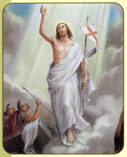
  

       Over the weekend of Good Friday, there was despair among the disciples who put their hopes and trust in their Master, but to their surprise.......HE IS RISEN as He truly said he would. Alleluia! That gave credibility, validation, and vindication to Christ's to His teachings and His saying that He is the Son of God. Without the Resurrection, Christ would go down in history as just another good man or just another prophet who was killed for what He believed.  

      By His resurrection, Christ conquered death, evil, and sin.  God made good come out of evil.  Since Our Lord rose again victorious, we also have the hope of rising again victorious and achieving everlasting happiness with Him in heaven.  No matter how difficult are the crosses we must bear on earth, we can accept and unite them with His cross, TRUSTING that our crosses will make us saints and OUR VICTORIOUS RESURRECTION WILL COME.  All that remained in the tomb was the shroud wrapping the body of Christ.  At the instant that Christ's soul gloriously reentered His body, there was a burst of radiation that scorched the shroud just enough to leave on it an image of the crucified Savior that He left for us to strengthen our weak faith.

       Other options include reading and reflecting during the recitation of this decade on Psalm 16:5-11; Jeremiah 20:10-11; Matthew 16:21-22; 17:22-23; 20:17-19; 27:57-28:15; Mark 15:42-16:13; Luke 23:50-24:48; John 2:19-22; 19:38-21:25; Acts 1:1-3, 21-22; 2:30-32; 4:33; 10:39-43; Romans 1:1-3; 6:3-14; 1Corinthians 15:3-8, 12-22; 1Peter1:18-21. 

The Second Glorious Mystery: The Ascension
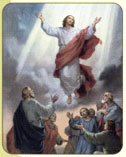
                                            

The eleven apostles went to Galilee, to the mountain to which Jesus had ordered them to go.  When they saw him, they worshiped, but they doubted.   Then Jesus approached and said to them, "All power in heaven and on earth has been given to me.  Go, therefore, and make disciples of all nations, baptizing them in the name of the Father, and of the Son, and of the Holy Spirit, teaching them to observe all that I have commanded you.  And behold, I am with you always, until the end of the age"  (Matthew 28:16-20).  Christ meant that not only for His apostles, but also for us to evangelize in little or big ways by prayer, by example and witness, by word, and by deed in our daily lives.......be it in the home, in parish functions or apostolates, in the community, in conversation, and even on the job.  

        He promised to always be with us, particularly in the Eucharist.  At the same time our Savior “is seated at the right hand of God, the Father almighty; from there he will come to judge the living and the dead.”  The apostles were sad to see their Master depart and now had to wait to be filled with the Holy Spirit (confirmed) to begin their great mission of evangelization.  Other options include reading and reflecting during the recitation of this decade on Mark 16:14-20; Luke 24:47-53; and Acts 1:6-12.   

The Third Glorious Mystery

 The Descent of the Holy Spirit
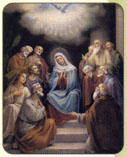
       Present were Mary and the apostles....... “When the time for Pentecost was fulfilled, they were all in one place together.  And suddenly there came from the sky a noise like a strong driving wind, and it filled the entire house in which they were.  Then there appeared to them tongues as of fire, which parted and came to rest on each one of them.  And they were all filled with the Holy Spirit and began to speak in different tongues, as the Spirit enabled them to proclaim” (Acts 2:1-4). 

    May the Holy Spirit renew in us the graces and His gifts of the sacrament of Confirmation as well as His fruits.  As soldiers of Christ, may we be always faithful to the Lord and His Church.  As were the first apostles, may we also be fearlessly on fire for the faith......to defend it, to spread it, and to share it with others no matter the cost.    Dear Holy Spirit, always tell us what to do, what to say, and what to write.  Other options include reading and reflecting during the recitation of this decade on Psalm 2:1-7; 104:30; 118:1-9,19-29; Ezekiel 37:14; Joel 3:1-5; Mark 16:14-20; John 3:5-8; 7:37-39; 14:15-28; 15:26-27; 20:19-23; Acts 1:4-5; 2:1-41; 3:12-26; 4:5-14; 23-31; Romans 8:22-27; 1 Corinthians 12:3-13; Galatians 5:13-26; 1 Peter 1:10-12.


The Fourth Glorious Mystery: 
The Assumption of Mary into Heaven

                                                    
        According to tradition, the apostles joyfully found only the most beautiful flowers where Mary previously laid in state.  Christ followed the 4th Commandment in honoring His mother by having her body and soul taken directly into His arms in Heaven.  Our Lord would not allow her body, a living tabernacle for nine months, the new Ark of the Covenant, to deteriorate in the earth. 

        Mary’s womb, the new Ark, did not contain manna, but the Bread of Life which is the Eucharist, Christ Himself.....not the staff of Aaron, but the Good Shepherd and High Priest who will offer Himself for us…..not the Ten Commandments, but the Son of God, who will speak for the Father.

        All of Heaven received Mary with immense joy.  Mother Mary, pray for us so that we may have a happy death as you had.  Other options include reading and reflecting during the recitation of this decade on Judith 13:18; Luke 1:39-56; 11:27-28; 1 Corinthians 15:20-27, 54-58; 1 Thessalonians 4:14-17; Revelation 11:19; 12:1.


The Fifth Glorious Mystery: 
The Coronation of Mary as Queen of Heaven & Earth


Imagine that you are there with all Heaven rejoicing in jubilation as Mary is gloriously crowned Queen of Heaven and Earth by her Son and the Father with the Holy Spirit looking on.   In the tradition of the Old Testament, the Queen Mother of Christ the King of the universe took her place of special honor and influence in the heavenly court.  From there our mother continues to intercede and pray for us and the world. 

Other options include reading and reflecting during the recitation of this decade on Judith 15:9-10; Revelation 12:1-6.  For meditations on the Joyful, Luminous, Sorrowful, and Glorious Mysteries of the rosary go to Blogs # 50, 73, 78, and 84 at paulrsebastianphd.blogspot.com.


Tuesday, May 1, 2012

(81) May Day and St. Joseph the Worker: Model of a True Man of God

MAY DAY

Images of the Hay Market Massacre, Chicago May 1886

          May 1 has been celebrated throughout the Communist world as May Day to commemorate the Hay Market Massacre in Chicago.  From April 25 to May 4, 1886 Chicago unionists, reformers, socialists, anarchists, and ordinary workers demonstrated for the eight hour day with the same pay as the normal ten at least 19 times with a dozen or so clashes with the police, three with shootings and two were killed.  At this time the union movement was in its infancy and met with vehement resistance by companies.  About 35,000 workers walked off their jobs with agitation for a general strike at all work places.  Police fired on strikers at the McCormick Reaper Plant; violence ensued; and police fired on the strikers, killing two.  

      Leaders called for a protest meeting at the Hay Market on the evening of May 4 with one inflammatory leaflet agitating for revenge.  Although the mayor who attended instructed the 177 police not to disturb the meeting, the officer in charge ordered the crowd to disperse.  Someone threw a bomb and the police fired indiscriminately into the crowd, much like the Kent State shootings on May 4, 1970 when inexperienced National Guardsmen killed four students died and injured several others (http://dept.kent.edu/sociology/lewis/lewihen.htm).  Sixty police were injured and eight died.  Many in the crowd were killed or wounded.  The city of Chicago then suppressed picketing, meetings, and the radical press.  Seven of the striking leaders were sentenced to death based on a conspiracy theory with little or no evidence.  It never was determined who threw the bomb (http://www.encyclopedia.chicagohistory.org/pages/571.html , http://dwardmac.pitzer.edu/anarchist_archives/haymarket/haymarket.html).

          In memory of the Hay Market Massacre Socialists and unionists around the world adopted May 1 or May Day as an international workers' holiday.  In the 20th Century the Soviet Union and the Communist World officially adopted it.  Thus it never caught on in the United States except for a period before World War I.  May Day is still celebrated in many nations of the world, especially in Latin America, Eastern Europe, and the communist countries (China, North Korea, Vietnam, Laos, and Cuba).  The communist countries have traditionally celebrated with big parades celebrating the Socialist Revolution with supposedly promises a workers paradise with equality and a equitable distributions of goods plus showing off their technological progress and modern armaments.  


          In reaction to the atheistic communist celebration of May Day in honor of their workers and the revolution against capitalism, Pope Pius XII adopted the same day, May 1 in 1955 as the Feast of St Joseph the Worker.  The painting below shows that Christ came from a working class family with St. Joseph the Carpenter as its head.  

ST. JOSEPH THE WORKER: 

MODEL OF A TRUE MAN OF GOD

  
      Why is St. Joseph a model of a true man of God? The Bible says little about St. Joseph and does not quote him at all. Yet the biblical accounts of St. Joseph demonstrate or imply several of his virtues; tradition shows others.....stories written and unwritten that have been handed down through the generations.

         Ever Chaste. According to tradition, Mary's parents, Joaquin and Ann asked God for a sign as to which man would be best for their daughter. Within a group of men St. Joseph's staff suddenly sprouted a white Lilly, a symbol of purity.  St. Joseph was ever chaste and able to control his passions and give up the privilege of having children of his own so that Mary could maintain her virginity as God willed.

        SensitivityWe see that in Matthew 1:18-21. When His mother Mary was betrothed (engaged) to Joseph, but before they lived together, she was found with child through the Holy Spirit. Joseph her husband, since he was a righteous man, yet unwilling to expose her to shame, decided to divorce her quietly. Such was his intention when, behold, the angel of the Lord appeared to him in a dream and said, “Joseph, son of David, do not be afraid to take Mary your wife into your home. For it is through the Holy Spirit that the child has been conceived in her.. She will bear a son and you are to name him Jesus, because he will save His people from their sins.”

        St. Joseph shows sensitivity in not exposing Mary to shame and protecting her from scandal or even stoning. Thus he tried to quietly separate from her. But Joseph obeys the angel without question and trusting in God, takes Mary into his home and provides for his wife and child. 

        Complying with the decree of Caesar Augustus for a census, Joseph took his pregnant wife on a trip of at least four days to travel the 80 miles from Nazareth to enroll in Bethlehem the city of David because he was a descendant of David. They had to patiently cope with the uncertainty that Mary would have to give birth on the side of the road as they continued to trust in God throughout their lives.  Thus they probably traveled slowly with frequent rest stops during a long, tiring, and bumpy ride.  According to tradition, Mary rode on a donkey and Joseph showed toughness in walking at her side. He did the same in the over 300 mile flight to Egypt and annual trips to the Temple in Jerusalem for the Passover. 
 
        Once in Bethlehem they could not find room in any of the inns and had to resort to the humiliation of staying in a stable. On top of that Mary gave birth to the Christ child. Joseph courageously coped with these difficulties, continued to trust, and made the best out of a bad situation which was transformed into the joy of the promised Messiah’s birth. 
 
        Obedient and Trust in God. To save the Christ child from Herod's slaughter of the holy innocents, Mathew 2:13-15 shows that the angel of the Lord appeared to Joseph in a dream and said, "Rise, take the child and his mother, flee to Egypt, and stay there until I tell you. Herod is going to search for the child to destroy him." Joseph rose and took the child and his mother by night and departed for Egypt. He stayed there until the death of Herod. In verses 19-20: When Herod had died, behold, the angel of the Lord appeared in a dream to Joseph in Egypt and said, "Rise, take the child and his mother and go to the land of Israel, for those who sought the child's life are dead." He rose, took the child and his mother, and went to the land of Israel. But when he heard that Archelaus was ruling over Judea in place of his father Herod, he was afraid to go back there.  And because he had been warned in a dream, he departed for the region of Galilee. He went and dwelt in a town called Nazareth, showing great prudence.

        Clearly, St. Joseph has the role of protector from the brutal Herod and on the long and arduous journey of a couple weeks to travel over 300 miles to an unknown land, Egypt. According to tradition, a Coptic church in Cairo Saints Sergius and Bacchus Church, also known as Abu Serga claims to be the site of the home of the Holy Family. Again, Joseph places his trust in the provident God and obeys. Again Joseph bends his will to the will of God, his plans to God's plans. On their return, St. Joseph is prudent in not returning via Judea for fear that Herod's son, Archelaus now king of Judea and even more violent than his father, would put the Holy Family in danger again. Thus Pope Leo XIII entrusted the Church to the protection of St. Joseph. Being a quiet man and dependent upon God, he demonstrated his humility.

        In the presentation in the Temple and going there every year for the Passover, St. Joseph is faithful to Jewish law. They presented and consecrated Mary's first born son to the Lord while sacrificing two young pigeons (Luke 2:22-24).

        When the 12 year old Christ child was lost in the Temple (Luke 2:41-52), Joseph and Mary had “great anxiety”. Surely thoughts of failure in their mission entered their minds, but Joseph must have had the faith that God was in control and would work it out.
 
        Physically Strong and RuggedSt. Joseph was a carpenter and according to custom trained his son in his trade.  They worked together during those hidden years which are not recorded in scripture.  We can only draw on tradition, private revelation to the mystic, Anne Catherine Emmerich as well as legend and speculation.  Holy pictures show a small carpenter shop for furniture making.  But some scholars say that St. Joseph and the young Jesus were construction carpenters that did heavy work.  Therefore both St. Joseph and his son were strong, rugged, and tough, epitomizing the dignity of work as creating with God.  St. Joseph was able to walk the 80 miles from Nazareth to Bethlehem and over 300 miles to Egypt.  This contradicts some popular depictions of St. Joseph as effeminate.  Thus Christ was able to walk all over Palestine and drag the cross or carry the crossbeam which weighed 100-150 pounds.  Clearly, St. Joseph served Mary and Jesus by being the breadwinner and by providing for the Holy Family.

        Piety. St. Joseph, being a pious man, certainly led his family in prayer and taught his son how to pray and observe the mosaic law.  He probably took the Holy Family to the synagogue every Saturday.  In his Gospel St. Luke (2:41) explicitly states in his Gospel: “Each year his parents went to Jerusalem for the Feast of the Passover”. Each time the angel communicated God's will that the Holy Family should flee to Egypt and again when to return, it was to Joseph, the head of the family. Clearly St. Joseph was the spiritual and material leader of the Holy Family. His quiet way indicated that he loved his family without being controlling.

         So we can see that St. Joseph was holy, a self-giving husband, a loving father, and a true man in every respect as God intended.  ST. JOSEPH, MODEL OF A TRUE MAN OF GOD, PRAY FOR US.

Note: For an excellent book see "St. Joseph and His World" by Mike Aquilina (www.scepterpublishers.org).  Well researched, it not only describes the role of St. Joseph in salvation history, but also beautifully describes the historical, socioeconomic, cultural, and environmental context of his role.  Thus it makes the scriptural passages involving St. Joseph come alive and gives insights on the hidden life of the Holy Family.  The first chapter gives an excellent summary of salvation history that was passed down from one generation to the next as the Jewish people waited in anticipation for the coming of the Messiah.