AMDG
Only eight weeks after receiving the statue of the International
Pilgrim Virgin of Fatima, St. Louis Church Gallipolis-Ohio is especially privileged
and blessed to receive the image of Our Lady of Guadalupe on the date that coincides
with her great feast day on December 12.
The Knights of Columbus is sending it to parishes all over the U.S. for
a day or two over the course of a year in its Marian Prayer Program as part of
the New Evangelization. We will receive
the large image the evening of Tuesday December 11 with benediction and rosary. The Blessed Sacrament will be exposed for
adoration through the night into her great feast with Mass in the evening……some
24 hours. In this Year of Faith, Mary
will continue her great mission of nurturing our faith and bringing us closer
to her son as she has done over the centuries.
As part of the spiritual
preparation for Christmas, individuals and parish groups are invited to sign up
for an hour of adoration as our Latin American families will do from 9-10 am on
Wednesday.
NUESTRA SENORA DE GUADALUPE
(II): MARY'S MESSAGE TO US IN THE IMAGE
During
the ten years after the conquest of Mexico in 1521, evangelization of the
Indians was painfully slow. Only about
30,000, a small fraction or 0.4% converted to the faith. St. Juan Diego was one of the few. The Indians resented their treatment by the
Spanish conquerors. Strife and unrest
increased. Bishop Juan de Zumárraga (see
his portrait below), a Franciscan who fought for better treatment of the
Indians, feared a full scale revolta blood bath.
He turned to Mary for help, praying to Our Lady for reconciliation and
peace. It is believed that he asked to receive roses
native to his homeland of Castile Spain as a sign that his prayer would be
answered. His prayer was answered through St. Juan
Diego in spectacular fashion on December 12, 1531 with the miraculous image of
her that she placed on his tilma beneath his cargo of Castilian roses as he
presented them to the Bishop.
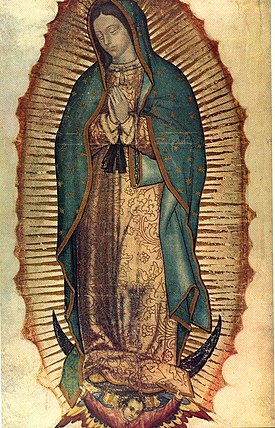

The Indians
could immediately relate to this icon of Mary, which was full of symbols they
could easily understand. Mother Mary
adapted to the Aztec culture by appearing in the dress of an Aztec
princess. She seemed to be one of them
and their mother too. Suddenly, they
could relate to the Church her son founded. The
Spanish missionaries did not have to go out and proselytize; the Indians eagerly
sought them out. In the short span of seven years the message of Nuestra Senora de
Guadalupe brought 8,000,000 Mexican Indians to the fold within seven years and
thus firmly established the faith in our hemisphere, roughly making up for the
losses to the Protestant Reformation. Note
in reading this article, how Mary ingeniously adapts her message to the Indian
culture. Clearly Mary, the patroness of the missions, is the greatest evangelizer of all time. Mother, in this
Year of Faith, pray that we become more firm with a deeper faith and to spread
it in every way we can. As you did in
the 16th Century, please reach fallen away Catholics, lukewarm
Catholics, and non-Catholics in the New Evangelization while nurturing our
faith.
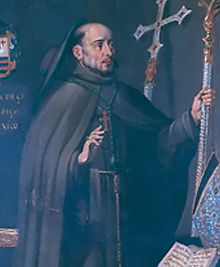
Juan de Zumárraga, the first Archbishop of Mexico City
The
question then arises: Exactly what does the image convey through its many
symbols to millions of Indians having the same gods, but 22 different
languages?
It
is interesting to note a parallel between the image and Indian customs and
culture. The Aztecs wrote their
histories by painting on cloth and in their codices (hieroglyphics) used
drawings and symbols instead of letters.
The figure of Nuestra Señora is shown blotting out the sun which they
adored. Only its rays are visible. Thus the human figure of the Mother of God is
shown as greater than the sun which therefore could not be God.
Another
important deity was Quetzalcoatl, the comet or sky serpent. According to Dr. Immanuel Velikovsky, there
actually was a great comet which passed close to Earth about 4,000 years ago
and caused great destruction. Interesting is that Halley's Comet passed close to earth at the time of Mary's appearance. For
centuries the Indians would sacrifice
hundreds, even thousands of prisoners and babies at their festivals to appease the Sky Serpent,
reminiscent of the dragon that appeared in the sky in Revelations 12:3 of the
Bible. Without realizing it, what they
had probably amounted to a form of satanic worship.
Evil certainly had considerable control of their religion and culture, much of the latter advanced in some ways for the times and beautiful, yet in other ways diabolical. The Aztecs at the time would wage war with their neighbors for the express purpose of obtaining prisoners for their human sacrifices…..as many as 50,000 per year…….a Culture of Death. Mary continued the work of her Son, who saved the Indians from the darkness. Today in essence “modern” mothers sacrifice their unborn babies to the idols of convenience and pleasure in abortion and euthanasia……another Culture of Death in some ways worse. Lord, save our world from the darkness that engulfs us today.
Evil certainly had considerable control of their religion and culture, much of the latter advanced in some ways for the times and beautiful, yet in other ways diabolical. The Aztecs at the time would wage war with their neighbors for the express purpose of obtaining prisoners for their human sacrifices…..as many as 50,000 per year…….a Culture of Death. Mary continued the work of her Son, who saved the Indians from the darkness. Today in essence “modern” mothers sacrifice their unborn babies to the idols of convenience and pleasure in abortion and euthanasia……another Culture of Death in some ways worse. Lord, save our world from the darkness that engulfs us today.
The
image of Mary convinced the Indians that they would no longer have to make
human sacrifices to appease it. The sky
serpent or moon god is represented as a crescent moon charred by the flames of
hell. The moon also symbolized
darkness. In addition Santa María (Holy
Mary or Saint Mary) is shown triumphantly standing upon the charred crescent moon
in the same manner as she is depicted crushing the same serpent over 300 years
later as the Immaculate Conception on the Miraculous Medal which she gave to
St. Catherine Labouré in her Paris convent in 1830 to distribute. Both remind us of Genesis 4:15……”I will put
enmity between you and the woman” and Revelations 12:1…….”A great sign appeared
in the sky, a woman clothed with the sun, with the moon under her feet, and on
her head a crown of twelve stars.” All
of this shows us that her son, the light of the world, triumphed over darkness
and evil.
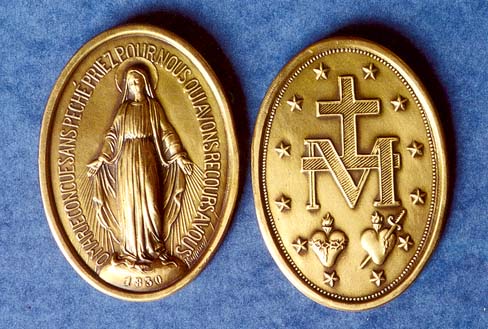
“Oh Mary, conceived without sin,
pray for us who have recourse to thee.”
Today
tourists can visit the Shrine of Nuestra Señora de Guadalupe in Mexico City and
the two large pyramids to the Sun (246 ft. in contrast to the Great Pyramid of
Egypt at 481 ft.) and the Moon (140 ft.) outside of the city. The Pyramid of the Moon is shown below. The Aztecs probably made human sacrifices
there as did their predecessors in the 6th Century. Our Lady of Guadalupe put a stop to human
sacrifices in Mexico. Our Lady of
Guadalupe, Patroness of the Unborn, please do the same with the human sacrifice
of babies through abortion in today’s world.
The
mantle of Nuestra Señora is blue green, which was the Indian color symbolizing
royalty as fit for the Queen of Heaven and Earth. Covering it with stars indicates that she
came from heaven and that the celestial bodies which they adored were not gods,
but instead were created to serve His creatures. Another interesting fact may be added about
the 130 foot Tepeyac Hill on which la Santísima (Most Holy) Virgin
appeared. Prior to the arrival of Hernán
Cortés, the conquistador, this region was dedicated to the worship of the
goddess, Teotenantzen which means Mother of God.
After
studying her figure, the Indians were sure that she had been an inhabitant of
earth at one time. Having made herself
visible to St. Juan Diego proved that the human soul is immortal. Her image also taught them that Maria Santísima
is not a goddess. While supported by an
angel, her hands are folded in supplication-- indicating that she is
interceding for us at the throne of the true invisible God. Her eyes are also cast downward, showing
humility and compassion as our mother and God’s messenger. Also, in Indian
iconography, a god looked straight ahead with wide open eyes.
On
her neck a small golden brooch with a black cross identifies Our Lady with the
cross which the Indians had seen on the banners of the troops of Hernán
Cortés. It convinced them that they
should embrace the religion of their conquerors and follow the Christ who is
symbolized by that cross and thus is greater than Mary. Thus in great numbers they eagerly sought the
missionaries in order to learn about the meaning of this cross. These Indians were astounded to hear that the
Son of God had offered Himself as human sacrifice for their salvation especially
since they for years had offered slaves, prisoners of war, and babies as human
sacrifices to their pagan god. See http://www.freerepublic.com/focus/f-religion/2147622/posts.
Furthermore,
Mary is wearing a black sash or bow (symbol of new life) around her waist,
indicating to the Indians that she is pregnant,
thus making her feast day in Advent a beautiful part of reliving the joyful
expectation of the long promised Messiah at Christmas. Therefore Our Lady of Guadalupe is also the Patroness of the Unborn. Furthermore,
the four pedal flower over her slightly enlarged womb symbolizes life. Her
blouse has a very high neck line, perhaps a message to women of today regarding
modest dress,
notwithstanding that the culture today is so different from any culture in
history.
In 1921 a
terrorist hid a stick of dynamite in a bouquet of flowers and placed it
within three feet of the image. Marble
blocks were torn out of the altar; every window was broken; and a brass
crucifix now on display in the shrine as shown above was badly deformed. In addition a painting of St. James behind
the image was destroyed. Yet not even a
crack appeared in the glass covering as the image was left completely
intact. Evil again tried to prevail, but
failed. God is in control. Through all of this the image has survived
and is beautifully preserved over the main altar almost as it actually was
nearly a century before the Mayflower touched our coast. Can it be then, that this divine work of art
also has a message and a significance particularly applicable to our modern but
chaotic times?

The
tilma of St. Juan Diego was hand woven from the fibers of the maguey cactus
plant, which has a lifespan of only twenty years. Since the material is rough, very absorbent,
and has a large seam running through the middle; it is most unsuitable for
painting. Through the years it has been
exposed to a 50% nitric acid solution that spilled on it, thousands of people
touching it, and the smoke of countless candles. Yet the colors have a bright freshness
instead of the expected dull and dark colors so common to other paintings of
the period. Turquoise paints in
particular fade very easily. The sun
burst does have some fading to indicate that it will pass away. Mysteriously,
the image has a constant temperature of 98.6 degrees Fahrenheit, the normal
body temperature,
In
1936, Fritz Hahn, a professor in Mexico City, took two fibers from the tilma……one
red, the other yellow, and then brought them to Germany for a close
examination. There, Dr. Richard Kuhn, Nobel Prize Winner and director of the
Department of Chemistry of the Kaiser Wilhelm Institute, came to the conclusion
that the fibers in question contained no known artificial coloring — neither
mineral, vegetal, animal, nor synthetic.
Attempts to duplicate the image on the same type of cloth worn by Juan
Diego failed. More recently a NASA
scientist and Dr. Philip C. Callahan, a biophysicist confirmed these findings with infrared analysis. Nor does the color penetrate the fibers. There is no over-varnish or under-drawing
(i.e., under-sketch) as standard in painting. The
stars on Mary’s mantle mirror exactly the positions of the visible constellations
before dawn on December 12, 1531, looking from many light years away, as if from
heaven. The flowers on her inner garment
follow a contour map of central Mexico, further indicating her queenship and
the encounter between and earth. See http://www.holyspiritinteractive.net/columns/williamsaunders/straightanswers/101.asp.
This
image is the only authentic portrait of Our Lady. It corresponds very well to the only known
detailed description of Mary's features made in 1821. This is described in the book, “The Life of the Blessed Virgin Mary from the
Visions of Anne Catherine Emmerich”.
A painting later discovered in the catacombs and a portrait of her said
to be painted by St. Luke also resemble the image. The height of the Virgin in the image
measures four feet eight inches which was probably her actual height. Her features are not really those of an
Indian maiden and while her color is slightly tan, it is not dark……a blend of
the Hebrew, the European, and the Indian.
She is Mother of all.
A Most Affectionate Motherly Message to Each One of Us. Let us close by quoting Nuestra Señora's own
words which have particular application to our lives, our special missions from
God, and work with its not infrequent frustrations. Here St. Juan Diego, as we so often do, is so
involved in the worries of this life and caring for his sick uncle that he
forgets to keep his appointment with Nuestra Señora. Thus in her last appearance she said to the
57 year old Indian in his language:
“Hear and let it penetrate
into your heart, my dear little son: Let
nothing discourage you, nothing depress you.
Let nothing alter your heart or your countenance. Also do not fear any illness or vexation,
anxiety, or pain. Am I not here, who am
your Mother? Are you not under my shadow
and protection? Am I not your fountain
of life? Are you not in the folds of my
mantle-- in the crossing of my arms? Is
there anything else you need? (Qué más te falta?)” At that moment his uncle was healed. These words are the most affectionate
expression by Mary of her motherly love to each one of us. Once again la Madre
de Dios (the Mother of God) personally reiterates her maternal function in the
Church as the mother of each one of us individually. Can she be any more precise, tender, and
loving in her declaration? Dear reader,
she’s also talking to you. Take this personally
and your love for Mary will grow.
Note:
Acknowledgments are due to Helen Behrens for much of the information in this
article. Her fascinating booklet,
“America's Treasure” together with a wealth of slides, pictures, and other
material in English as well as Spanish is available from her English
Information Center at Apartado 26732.
Furthermore, I enjoyed so much talking to her and listening to her
explanations. May she rest in peace.
Books on Our Lady of Guadalupe
Warren H. Carroll: Our Lady of Guadalupe and the Conquest of
Darkness
Franciscan Friars of the
Immaculate: Handbook on Guadalupe
Fr. Christopher Rengers: Mary of
the Americas


